“To forget the dead would be akin to killing them a second time.” (Elie Wiesel)
For approximately the past 2 1/2 years, I have devoted a considerable amount of time and personal energy to exploring the holocaust of world war II. In this post, I want to summarize the most significant aspects of this journey as well as my personal reflections on the experience.
My interest in the holocaust really began when I was teaching in a study abroad program in Scotland during Fall semester, 2009. Toward the end of the term, one of my favorite students visited Poland, including Auschwitz. Upon her return, she showed me pictures, and I was dumbfounded. Though I had read Victor Frankl’s “Man’s Search for Meaning” during college, I had not really been seriously interested in the holocaust before (I mostly was interested in the humanistic insights from Frankl’s book, not his account of life in concentration camps). This student gave me a copy of Elie Wiesel’s “Night” to read.
Wiesel’s writing is captivating and disturbing. I found that I couldn’t put the book down. In particular, I had a strong reaction to Wiesel’s description of his arrival at Auschwitz, especially when he writes that “babies were thrown into the air and the machine gunners used them as targets.” I had heard some stories about Auschwitz, but the details of this book, and particularly the treatment of the children, shocked me. I also was fascinated by the brutal honesty Wiesel shows regarding his Jewish faith when he reflects during a time of ritual prayer. He writes:
“On the eve of Rosh Hashanah, the last day of that cursed year, the entire camp was agitated and every one of us felt the tension. . . On the Appelplatz, surrounded by electrified barbed wire, thousands of Jews, anguish on their faces, gathered in silence. . . Some ten thousand men had come to participate in a solemn service. . . ‘Blessed by the Almighty. . .’ . . . Blessed be God’s name? Why, but why would I bless Him? Every fiber in me rebelled. Because He caused thousands of children to burn in His mass graves? Because he kept six crematoria working day and night, including Sabbath and the Holy Days? Because in His great might, He had created Auschwitz, Birkenau, Buna, and so many other factories of death? How could I say to Him: Blessed be Thou, Almighty, Master of the Universe, who chose us among all nations to be tortured day and night, to watch as our fathers, our mothers, our brothers, end up in the furnaces? Praised be Thy Holy Name, for having chosen us to be slaughtered on Thine altar?. . . When Adam and Eve deceived You, You chased them from paradise. When You were displeased by Noah’s generation, You brought down the Flood. When Sodom lost Your favor, You caused the heavens to rain down fire and damnation. But look at these men whom You have betrayed, allowing them to be tortured, slaughtered, gassed, and burned, what do they do? They pray before You! They praise Your name!”
A few months later, the global studies coordinator at my college, Dan Creed, visited our department to encourage us to consider short-term study abroad opportunities. Eventually, my colleague, Dr. Jay Anderson, and I decided to teach a course in the psychology of the holocaust during Spring semester, 2012.
To begin to recruit for the course, we followed Dan’s advice to bring in a concentration camp survivor during the college’s “Success Day,” Josef Rozenberg. The audience was transfixed at Joe’s presentation about his personal experience in two concentration camps. Old timers have since told me that they had never seen more people attend an event at the college. The auditorium literally was overflowing, with an estimated crowd of 700 people.

Josef Rozenberg at Success Day, Normandale Community College, March 8, 2011.
The previous summer, I ran into an old friend, Dr. Andy Johnson from Bethel University, at the Annual Meeting of the American Psychological Association in San Diego. Andy informed me of special seminars offered by the United States Holocaust Memorial Museum in Washington, D.C. to help college professors to become knowledgeable enough to teach their holocaust courses effectively. I applied for, and was accepted to attend, a one-week seminar with 19 other faculty, mostly historians with expertise in the holocaust. During this week, I learned a lot from these colleagues. I met two concentration camp survivors and was fully immersed in the topic. I was particularly struck by the details of what occurred to the victims. For example, a clear picture was painted of the deportation and the ride to the concentration camps. Individuals had to stand in the cattle cars. There was no toilet. Women may have been menstruating. People obviously would be terrified. Screams likely filled the cars. I have a hard time even imagining the fright of this ordeal. At the end, all I could do was sit quietly in the hall of remembrance and pray.
Another significant part of my journey to understand the holocaust has been to personally get to know Dr. Robert Fisch, another survivor of two concentration camps. Dr. Fisch probably is best known for his remarkable life after the holocaust, including his discovery of PKU, a genetic problem that contributes to mental retardation in some children. My relationship with Dr. Fisch has influenced me in many ways. In particular, I think of his maxim to always remember to “treat people humanely, even in inhumane circumstances.” It also has meant a lot to me that Dr. Fisch has gotten to know my family. For instance, when I went on my trip to Europe to visit holocaust sites, my kids explained my absence by telling people that my wife and I were there to see about the family that Dr. Fisch lost.

Dr. Robert Fisch with my family, December 6, 2011.
The pinnacle of my exploration of the holocaust has been my trip with 28 students enrolled in my psychology of the holocaust course to sites in central and eastern Europe. In general, the holocaust casts a dark shadow in the locations we visited: Berlin (Germany), Prague (Czech Republic), Krakow (Poland), and Budapest (Hungary). The history of each of these cities – much of Europe in fact – now features stories about the holocaust.
Perhaps the most powerful part of the trip for me was the Jewish Museum in Berlin. The architecture and layout of the museum is unlike any other museum I’ve ever seen. Its basic purpose appears to be to engage the visitor. That is, rather than merely reading or imagining the topics, the visitor is drawn into a personal experience.
When viewing the “Garden of Exile,” I was led to be off-balance. The floor was tilted, as were the stone monuments outside. The feeling was that of being disoriented, surely a common feeling among Jews throughout history.

The Garden of Exile at the Jewish Museum, Berlin, Germany.
After this, my wife and I walked up a tilted hallway toward what was supposed to be the Holocaust Tower. There was a guard standing nearby an ominous looking steal door. Not sure where the tower was, I said I’d go in. I pushed the heavy door open and let it go. It slammed shut, and I had a sense of what it would feel like to be captured. Unlike the main part of the museum, the tower was unheated, meaning that it was cold. I was there, by myself, surrounded by three stories of concrete. I felt very helpless, another common feeling of the Jewish people throughout history.

Holocaust Tower, Jewish Museum, Berlin, Germany.
We then progressed to the Memory Void, an open area of the Museum meant to capture the sense of loss from those killed in the Holocaust. While walking through the area, we heard a strange clanking sound. Eventually, we reached the end, where we witnessed an area consisting of iron faces that we were led to believe we must walk across. Some faces were bigger (surely meant to represent adults); some were smaller (surely meant to represent children). Walking across was horrific. It wasn’t until the end that I realized that there actually was a “dead end;” I didn’t have to walk across the faces, but now that I was at the end, I did have to walk across them again to get out. It was unavoidable to think about the sense of harm to the Jewish people and the ways in which individuals have been “tricked” to contribute to that harm throughout history.
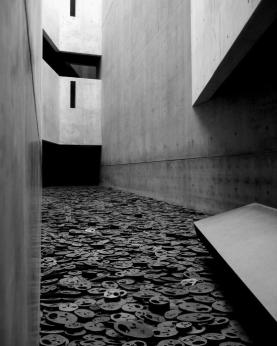
Memory Void, Jewish Museum, Berlin, Germany.
At the end of this time at the Jewish Museum, I honestly felt sick to my stomach. I couldn’t understand why such harm would be done to a group of people, why 11,000,000 could be murdered because of the twisted ideas of a few and the mass hysteria of an era. I wondered about the ways in which I had actively or passively contributed to harm in the world, and how I wanted to correct that in the future. That night, I prayed in a different way.
Several days later, we made the bus ride to Auschwitz. As we approached the city of Oswiecim, everyone I was with became silent. Along with others, I wondered how I was going to react to what is now regarded as the epicenter of human evil, the largest cemetary in the world. We began with Auschwitz I, the main concentration camp portion of the complex. Although I had encountered some personal items (e.g., shoes) at my stay at the United States Holocaust Memorial Museum, the number of personal items at Auschwitz was overwhelming. There were shoes, eyeglasses, suitcases, kitchen items, brushes, prayer shawls, and, most disturbing, sheared human hair, of murdered prisoners. It would have been easy to distract myself, but I tried to face the horror of this, to imagine who this would have come from, to appreciate the full force of what transpired.

Human hair at Auschwitz I, Oswiecim, Poland.
We then bused a short distance to Auschwitz II – Birkenau – the largest extermination camp of the Nazi regime in which approximately 2,500,000 were killed. I couldn’t help but remember that, as I walked through this enormous complex, I was walking on the ashes of the deceased. Strange things are reported at Birkenau. Some students said they could smell the ashes; some have said that no birds fly overhead. I can’t confirm or deny these reports; all I can say for sure is that I felt like I was walking on hallowed ground. This feeling was enhanced by the fact that our group was the last of the day. We were alone. It was the only day of our trip where I felt truly cold, partially because of the weather and partially because of the feeling of the place. And, yet, ironically, on one side of the complex we saw a beautiful sunset, and on the other, we saw the full moon rise.

Auschwitz II, Oswiecim, Poland, March 8, 2012.
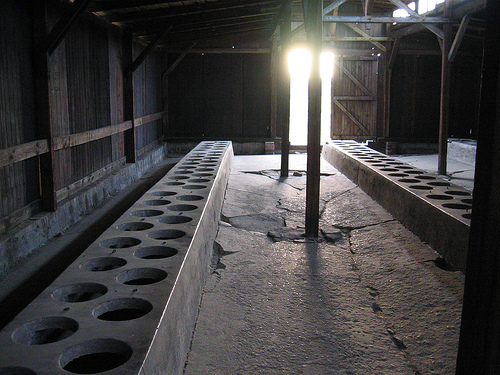
As a part of our visit, we also toured the bunking area where people slept while they waited to be killed, wooden slats where up to four prisoners squeezed together. We viewed the toilets that prisoners were allowed to use for 1-2 minutes once in the morning and once at night (obviously, they probably needed longer sometimes and, obviously, there were other times they needed to use the toilets, but typically were not allowed). I only can imagine the inhumane conditions of this – the stench, the rats, etc. – but the coldness of the night helped me to appreciate the living conditions, particularly when trying to use cement toilets.

Toilets at Auschwitz II – Oswiecim, Poland.
Overall, I believe that this personal exploration of the holocaust has influenced me in several ways. Although I obviously didn’t personally experience any of these tragedies, I feel like I did look squarely into the depths of human evil. I intentionally did not turn away from it, but rather decided to feel it. This made the experience much more profound. It has left me with the sense that I can feel very difficult human emotions and be okay. Furthermore, it has helped me to better appreciate the full scale of potential human suffering, which has cast an optimistic reframe around petty problems I have in my daily life.
These sentiments are echoed and reinforced by Victor Frankl, concentration camp survivor and author of “Man’s Search for Meaning.” In this classic, Frankl profoundly and inspirationally reflects on what he observed during camp life:
“The experiences of camp life show that man does have a choice of action. There were enough examples, often of a heroic nature, which proved that apathy could be overcome, irritability suppressed. Man can preserve a vestige of spiritual freedom, of independence of mind, even in such terrible conditions of psychic and physical stress. . . everything can be taken from a man but one thing: the last of the human freedoms – to choose one’s attitude in any given set of circumstances, to choose one’s own way. . . Even though conditions such as lack of sleep, insufficient food and various mental stresses may suggest that the inmates were bound to react in certain ways, in the final analysis it becomes clear that the sort of person the prisoner became was the result of an inner decision, and not the result of camp influences alone. Fundamentally, therefore, any man can, even under such circumstances, decide what shall become of him – mentally and spiritually. . . It is this spiritual freedom – which can not be taken away – that makes life meaningful and purposeful.”
Maybe in the end, my exploration of the holocaust shows that I am an optimist. I suppose I could dwell on the negative – and surely there’s enough negative to dwell on. However, I can’t escape from wanting to find lessons, to find meaning, to seek hope, and to recommit to what is good.

Flowers at Auschwitz II Memorial, Oswiecim, Poland, March 8, 2012.
 However, for various reasons, many seem to get overly focused on one kind of love and neglect one or more of the others.



 Andy Tix