In his op-ed, “The Subtle Sensations of Faith,” David Brooks calls “My Bright Abyss: Meditation of a Modern Believer,” “the best modern book on belief.” The author, Christian Wiman, has struggled – for many years – with a rare form of cancer, and he lays bare many of his rawest thoughts in this book about many aspects of meaningful living, particularly in relation to faith. I think the best way to give a quick glimpse is to share a few select passages.
***
“No one ever believed in God without perceiving God.”
“To say that one must live in uncertainty doesn’t begin to get at the tenuous, precarious nature of faith. The minute you begin to speak with certitude about God, he is gone. We praise people for having strong faith, but strength is only one part of that physical metaphor: one also needs flexibility.”

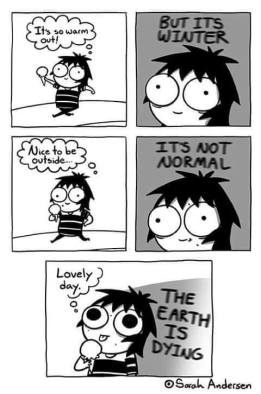 We may be bearing witness to the dawning of a new human experience: “warm weather ambivalence.” This experience may take somewhat different forms in different locations, but in places where there are four seasons, above average temperatures in Fall, Winter, and Spring may yield mixed feelings for some people. The recent unseasonably warm weather across much of the United States is illustrative. On one hand, we are delighted by the warmth as we feel the energy of the sun on our skin and we feel freed from some of the constraints of Winter. On the other hand, some of us sense that something has changed – and is changing – for the worse.
 Andy Tix