Category Archives: Uncategorized

My Personal Exploration of the Holocaust

“To forget the dead would be akin to killing them a second time.” (Elie Wiesel)

For approximately the past 2 1/2 years, I have devoted a considerable amount of time and personal energy to exploring the holocaust of world war II. In this post, I want to summarize the most significant aspects of this journey as well as my personal reflections on the experience.

My interest in the holocaust really began when I was teaching in a study abroad program in Scotland during Fall semester, 2009. Toward the end of the term, one of my favorite students visited Poland, including Auschwitz. Upon her return, she showed me pictures, and I was dumbfounded. Though I had read Victor Frankl’s “Man’s Search for Meaning” during college, I had not really been seriously interested in the holocaust before (I mostly was interested in the humanistic insights from Frankl’s book, not his account of life in concentration camps). This student gave me a copy of Elie Wiesel’s “Night” to read.

Wiesel’s writing is captivating and disturbing. I found that I couldn’t put the book down. In particular, I had a strong reaction to Wiesel’s description of his arrival at Auschwitz, especially when he writes that “babies were thrown into the air and the machine gunners used them as targets.” I had heard some stories about Auschwitz, but the details of this book, and particularly the treatment of the children, shocked me. I also was fascinated by the brutal honesty Wiesel shows regarding his Jewish faith when he reflects during a time of ritual prayer. He writes:

“On the eve of Rosh Hashanah, the last day of that cursed year, the entire camp was agitated and every one of us felt the tension. . . On the Appelplatz, surrounded by electrified barbed wire, thousands of Jews, anguish on their faces, gathered in silence. . . Some ten thousand men had come to participate in a solemn service. . . ‘Blessed by the Almighty. . .’ . . . Blessed be God’s name? Why, but why would I bless Him? Every fiber in me rebelled. Because He caused thousands of children to burn in His mass graves? Because he kept six crematoria working day and night, including Sabbath and the Holy Days? Because in His great might, He had created Auschwitz, Birkenau, Buna, and so many other factories of death? How could I say to Him: Blessed be Thou, Almighty, Master of the Universe, who chose us among all nations to be tortured day and night, to watch as our fathers, our mothers, our brothers, end up in the furnaces? Praised be Thy Holy Name, for having chosen us to be slaughtered on Thine altar?. . . When Adam and Eve de­ceived You, You chased them from par­adise. When You were dis­pleased by Noah’s generation, You brought down the Flood. When Sodom lost Your fa­vor, You caused the heav­ens to rain down fire and damna­tion. But look at these men whom You have be­trayed, al­low­ing them to be tortured, slaugh­tered, gassed, and burned, what do they do? They pray be­fore You! They praise Your name!”

A few months later, the global studies coordinator at my college, Dan Creed, visited our department to encourage us to consider short-term study abroad opportunities. Eventually, my colleague, Dr. Jay Anderson, and I decided to teach a course in the psychology of the holocaust during Spring semester, 2012.

To begin to recruit for the course, we followed Dan’s advice to bring in a concentration camp survivor during the college’s “Success Day,” Josef Rozenberg. The audience was transfixed at Joe’s presentation about his personal experience in two concentration camps. Old timers have since told me that they had never seen more people attend an event at the college. The auditorium literally was overflowing, with an estimated crowd of 700 people.

Josef Rozenberg at Success Day, Normandale Community College, March 8, 2011.

The previous summer, I ran into an old friend, Dr. Andy Johnson from Bethel University, at the Annual Meeting of the American Psychological Association in San Diego. Andy informed me of special seminars offered by the United States Holocaust Memorial Museum in Washington, D.C. to help college professors to become knowledgeable enough to teach their holocaust courses effectively. I applied for, and was accepted to attend, a one-week seminar with 19 other faculty, mostly historians with expertise in the holocaust. During this week, I learned a lot from these colleagues. I met two concentration camp survivors and was fully immersed in the topic. I was particularly struck by the details of what occurred to the victims. For example, a clear picture was painted of the deportation and the ride to the concentration camps. Individuals had to stand in the cattle cars. There was no toilet. Women may have been menstruating. People obviously would be terrified. Screams likely filled the cars. I have a hard time even imagining the fright of this ordeal. At the end, all I could do was sit quietly in the hall of remembrance and pray.

Another significant part of my journey to understand the holocaust has been to personally get to know Dr. Robert Fisch, another survivor of two concentration camps. Dr. Fisch probably is best known for his remarkable life after the holocaust, including his discovery of PKU, a genetic problem that contributes to mental retardation in some children. My relationship with Dr. Fisch has influenced me in many ways. In particular, I think of his maxim to always remember to “treat people humanely, even in inhumane circumstances.” It also has meant a lot to me that Dr. Fisch has gotten to know my family. For instance, when I went on my trip to Europe to visit holocaust sites, my kids explained my absence by telling people that my wife and I were there to see about the family that Dr. Fisch lost.

Dr. Robert Fisch with my family, December 6, 2011.

The pinnacle of my exploration of the holocaust has been my trip with 28 students enrolled in my psychology of the holocaust course to sites in central and eastern Europe. In general, the holocaust casts a dark shadow in the locations we visited: Berlin (Germany), Prague (Czech Republic), Krakow (Poland), and Budapest (Hungary). The history of each of these cities – much of Europe in fact – now features stories about the holocaust.

Perhaps the most powerful part of the trip for me was the Jewish Museum in Berlin. The architecture and layout of the museum is unlike any other museum I’ve ever seen. Its basic purpose appears to be to engage the visitor. That is, rather than merely reading or imagining the topics, the visitor is drawn into a personal experience.

When viewing the “Garden of Exile,” I was led to be off-balance. The floor was tilted, as were the stone monuments outside. The feeling was that of being disoriented, surely a common feeling among Jews throughout history.

The Garden of Exile at the Jewish Museum, Berlin, Germany.

After this, my wife and I walked up a tilted hallway toward what was supposed to be the Holocaust Tower. There was a guard standing nearby an ominous looking steal door. Not sure where the tower was, I said I’d go in. I pushed the heavy door open and let it go. It slammed shut, and I had a sense of what it would feel like to be captured. Unlike the main part of the museum, the tower was unheated, meaning that it was cold. I was there, by myself, surrounded by three stories of concrete. I felt very helpless, another common feeling of the Jewish people throughout history.

Holocaust Tower, Jewish Museum, Berlin, Germany.

We then progressed to the Memory Void, an open area of the Museum meant to capture the sense of loss from those killed in the Holocaust. While walking through the area, we heard a strange clanking sound. Eventually, we reached the end, where we witnessed an area consisting of iron faces that we were led to believe we must walk across. Some faces were bigger (surely meant to represent adults); some were smaller (surely meant to represent children). Walking across was horrific. It wasn’t until the end that I realized that there actually was a “dead end;” I didn’t have to walk across the faces, but now that I was at the end, I did have to walk across them again to get out. It was unavoidable to think about the sense of harm to the Jewish people and the ways in which individuals have been “tricked” to contribute to that harm throughout history.

Memory Void, Jewish Museum, Berlin, Germany.

At the end of this time at the Jewish Museum, I honestly felt sick to my stomach. I couldn’t understand why such harm would be done to a group of people, why 11,000,000 could be murdered because of the twisted ideas of a few and the mass hysteria of an era. I wondered about the ways in which I had actively or passively contributed to harm in the world, and how I wanted to correct that in the future. That night, I prayed in a different way.

Several days later, we made the bus ride to Auschwitz. As we approached the city of Oswiecim, everyone I was with became silent. Along with others, I wondered how I was going to react to what is now regarded as the epicenter of human evil, the largest cemetary in the world. We began with Auschwitz I, the main concentration camp portion of the complex. Although I had encountered some personal items (e.g., shoes) at my stay at the United States Holocaust Memorial Museum, the number of personal items at Auschwitz was overwhelming. There were shoes, eyeglasses, suitcases, kitchen items, brushes, prayer shawls, and, most disturbing, sheared human hair, of murdered prisoners. It would have been easy to distract myself, but I tried to face the horror of this, to imagine who this would have come from, to appreciate the full force of what transpired.

Human hair at Auschwitz I, Oswiecim, Poland

Human hair at Auschwitz I, Oswiecim, Poland.

We then bused a short distance to Auschwitz II – Birkenau – the largest extermination camp of the Nazi regime in which approximately 2,500,000 were killed. I couldn’t help but remember that, as I walked through this enormous complex, I was walking on the ashes of the deceased. Strange things are reported at Birkenau. Some students said they could smell the ashes; some have said that no birds fly overhead. I can’t confirm or deny these reports; all I can say for sure is that I felt like I was walking on hallowed ground. This feeling was enhanced by the fact that our group was the last of the day. We were alone. It was the only day of our trip where I felt truly cold, partially because of the weather and partially because of the feeling of the place. And, yet, ironically, on one side of the complex we saw a beautiful sunset, and on the other, we saw the full moon rise.

Auschwitz II, Oswiecim, Poland, March 8, 2012.

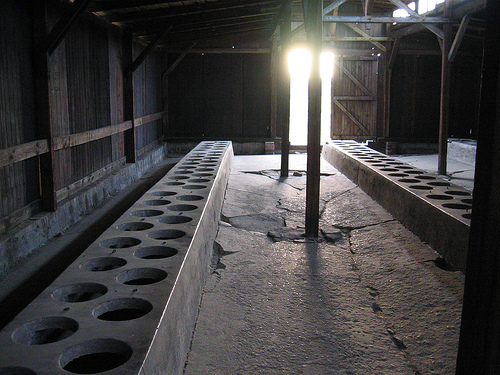
As a part of our visit, we also toured the bunking area where people slept while they waited to be killed, wooden slats where up to four prisoners squeezed together. We viewed the toilets that prisoners were allowed to use for 1-2 minutes once in the morning and once at night (obviously, they probably needed longer sometimes and, obviously, there were other times they needed to use the toilets, but typically were not allowed). I only can imagine the inhumane conditions of this – the stench, the rats, etc. – but the coldness of the night helped me to appreciate the living conditions, particularly when trying to use cement toilets.

Toilets at Auschwitz II – Oswiecim, Poland.

Overall, I believe that this personal exploration of the holocaust has influenced me in several ways. Although I obviously didn’t personally experience any of these tragedies, I feel like I did look squarely into the depths of human evil. I intentionally did not turn away from it, but rather decided to feel it. This made the experience much more profound. It has left me with the sense that I can feel very difficult human emotions and be okay. Furthermore, it has helped me to better appreciate the full scale of potential human suffering, which has cast an optimistic reframe around petty problems I have in my daily life.

These sentiments are echoed and reinforced by Victor Frankl, concentration camp survivor and author of “Man’s Search for Meaning.” In this classic, Frankl profoundly and inspirationally reflects on what he observed during camp life:

“The experiences of camp life show that man does have a choice of action. There were enough examples, often of a heroic nature, which proved that apathy could be overcome, irritability suppressed. Man can preserve a vestige of spiritual freedom, of independence of mind, even in such terrible conditions of psychic and physical stress. . . everything can be taken from a man but one thing: the last of the human freedoms – to choose one’s attitude in any given set of circumstances, to choose one’s own way. . . Even though conditions such as lack of sleep, insufficient food and various mental stresses may suggest that the inmates were bound to react in certain ways, in the final analysis it becomes clear that the sort of person the prisoner became was the result of an inner decision, and not the result of camp influences alone. Fundamentally, therefore, any man can, even under such circumstances, decide what shall become of him – mentally and spiritually. . . It is this spiritual freedom – which can not be taken away – that makes life meaningful and purposeful.”

Maybe in the end, my exploration of the holocaust shows that I am an optimist. I suppose I could dwell on the negative – and surely there’s enough negative to dwell on. However, I can’t escape from wanting to find lessons, to find meaning, to seek hope, and to recommit to what is good.

Flowers at Auschwitz II Memorial, Oswiecim, Poland, March 8, 2012.

A New Focus for School Reform: The Student

Solving America’s education problems continues to be a conundrum. Our educational system poses unique dilemmas including diverse students, curricular choice, and even the purpose of education. Given the persistent and discouraging results in trying to improve our educational system, it is time to seriously rethink our ideas about school reform.

The most overlooked and most important aspect of education reform is the student. This long has been the case. Writing in the early 20th century, education theorist, John Dewey, argued that “the center of gravity is outside the child. It is the teacher, the textbook, anywhere and everywhere you please except in the immediate instincts and activities of the child.”

Jean Piaget, who first championed the understanding of children’s cognitive development, also stressed the importance of the student’s role in education. As Piaget stated, “Knowledge is not given to the passive observer, rather it must be discovered and constructed by the activities of the child.” Although others can help, ultimately, knowledge is created by the student alone.

It is time that we look at the school experience through the eyes of the students. It is also time to think beyond the usual reform targets and consider students as a focus of change.

Continue reading

Balance in Life

In a very candid reflection on his the current state of medicine in our culture, Dr. Richard Swensen writes:

“Patients don’t know what to do or where to turn. They have no social supports, no roots, no community. Their stomachs won’t stop burning. They can’t sleep at night. They think about drastic solutions. The public blames the medical profession for giving too many tranquilizers and antidepressants. But what would you do? Doctors like to see healing as a result of their work. Yet today we often must be content with far less. There are so many things wrong with people’s lives that even our best is only a stopgap.”

In his book, “Margin,” Swensen seeks to pinpoint the underlying cause of Western medical problems, and to point toward some real solutions. His general thesis is that many have lost the “margin” in their lives to restore balance and that this “margin” must be regained if health is to result in the long-term.

Continue reading

Favorite Proverbs

One of the most intriguing books of the Bible is the book of Proverbs, which contains sayings intended to promote wisdom in readers. I’ve been reading these Proverbs for the past few months. Below are some of my favorites:

“Trust in the Lord with all your heart and lean not on your own understanding; in all your ways acknowledge him, and he will keep your paths straight.” (3:5-6)

“Above all else, guard your heart, for everything you do flows from it.” (4:23)

“Plans fail for lack of counsel, but with many advisers they succeed.” (15:22)

“Pride goes before destruction, a haughty spirit before a fall.” (16:18)

“Whoever would foster love covers over an offense, but whoever repeats the matter separates close friends.” (17:9)

“A cheerful heart is good medicine, but a crushed spirit dries up the bones.” (17:22)

“Fools find no pleasure in understanding but delight in airing their own opinions.” (18:2)

“Listen to advice and accept discipline, and at the end you will be counted among the wise.” (19:20)

“Who can say, ‘I have kept my heart pure; I am clean and without sin?'” (20:9)

“Start children off on the way they should go, and even when they are old they will not turn from it.” (22:6)

“Let someone else praise you, and not your own mouth; an outsider, and not your own lips.” (27:2)

“As iron sharpens iron, so one person sharpens another.” (27:17)

“As water reflects the face, so one’s life reflects the heart.” (27:19)

“Blessed are those who always tremble before God, but those who harden their hearts fall into trouble.” (28:14)

The Psychology of Spiritual Experience

“How does God become real to people when God is understood to be invisible and immaterial, as God is within the Christian tradition?” So begins one of several fascinating scholarly articles regarding the psychology of spiritual experience by a Stanford anthropologist by the name of Tanya Luhrmann.

Many of Luhrmann’s ideas about this question come from her ethnographic study of a Vineyard church in Chicago in which she involved herself in two years of Sunday morning services, a weekly Bible study housegroup, conferences, retreats, and casual conversations. Importantly, Luhrmann notes that individuals she observed in her research seemed to differ in their ability to “experience God.” For instance, members of the congregation acknowledged that:

“. . . each person would experience God in their own way and develop their own pattern of learning to recognize him: some through warm tingling; others through goose bumps; others still through images or impressions or scriptural phrases.”

Yet, others in Luhrmann’s research noted that they had a difficult time with spiritual experience. One person commented that “I don’t have these supernatural experiences that make me fall to my knees.”

Why do some seem more able to experience God than others?

Continue reading

The Psychology of a Nazi Extermination Camp Commandant

I just finished the most remarkable book: “Into That Darkness,” by Gitta Sereny. This book is organized around 70 hours of interviews that the author conducted with Franz Stangl, a leader in the Third Reich who worked at the T4 euthanasia program in Berlin and who commanded the Sobibor and Treblinka extermination camps. He was the only Commandant of a camp brought to trial, and ultimately was sentenced to a life sentence in prison.

First, a little background information I learned while reading the book. When most people think about the most horrific aspects of Nazism, they typically think of the concentration camps in which millions of Jews, Roma, political prisoners, and others worked and died. The primary purpose of concentration camps was work, however, and many fortunate individuals survived. Far less attention is given to the Nazi extermination camps, of which there only were four (or five, depending on whether one counts Birkenau, connected with Auschwitz). These camps were built exclusively to kill people, and very few survived. Stangl was the Commandant of two of these, overseeing the deaths of approximately 1,000,000.

There appear to be many reasons why Stangl was involved in such horrors. I was struck by how Stangl appeared to go along with the Nazi plan out of fear of punishment. At every “advancement” in the system, Stangl seemed to speak of his fear for his survival (or his family’s). At the same time, Stangl appeared to be motivated to be effective in carrying out his work, and hoped for promotions. Much of this seemed to be gradual, the “foot-in-the-door” process that often leads people to changes in beliefs and behavior. For instance, a key development in Stangl’s slow moral erosion came when he signed a card signifying that he gave up his allegiance to the Catholic Church (but not to God). Ultimately, it seemed that Stangl started to rationalize his behavior, such as when he said he thought it was okay to euthanize Jews because a Catholic scholar said that the Church didn’t necessarily disagree, that there always has been a debate about euthanasia. Another example of Stangl’s rationalization occurred when he emphasized that he only was the overseer of the camp and that he never was directly involved in killing anyone. He began to operate on two different levels, one with his buddies and at home with his wife and children, and another when he conducted his operations. In fact, Stangl even lost the ability to recognize the Jewish children as people. Generally, he didn’t think of the individuals he killed, but rather the effectiveness of the operations.

Interestingly, much of Stangl’s psychology appeared to be designed by higher authorities. It seemed that many involved in the euthanasia program were given more authority because they were desensitized to suffering at that location. As another example, I was struck by one passage that suggests that the Jews were humiliated publicly in front of the Nazis so that the Nazis would come to dehumanize them.

I long have thought that it might have been easier to overcome the horrors of World War 2, that perhaps if more individuals had resisted, none of this would have happened. However, in reading this book, I started to realize that many individuals involved really seemed to be quite powerless. At least they felt that way. For example, Stangl once commented that:

“If I had sacrificed myself. . . if I had made public what I felt, and had died. . . it would have made no difference. Not an iota. It would all have gone on just the same, as if it and I had never happened.”

In thinking more about this, it seemed that there were several likely candidates for making a significant difference in these crimes. First, those who harbored individuals at risk obviously helped them, although this didn’t change much of the grand scope of what transpired. Second, in this book, a strong case is made that the Pope may have been able to substantially influence the course of events if he had taken a strong, public stand (obviously, he failed in doing so). In fact, Hitler stopped the euthanasia program immediately after a sermon condemning the program was delivered in Rome. Finally, I was interested in the relationship between Stangl and his wife. She is interviewed for the book as well and, when asked hypothetically what she thought might have happened if she had presented an ultimatum to the Commandant to either continue to go along with the Nazis or she and her kids would leave, she thought that he would have stopped (although, significantly, later she said this wasn’t true, perhaps as a rationalization for her failure to do more).

In the end, though, reading this book really left me shaking my head. One particular passage mystifies me. In this passage, one of the guards at Treblinka states:

“A mother jumps down with her baby and calmly looks into a pointing gun-barrel – a moment later we hear the guard who shot them boast to his fellows that he managed to ‘do’ them both with one shot through both their heads.”

I believe that there were social-psychological factors involved in the Holocaust, but ultimately, I think these events speak to the evil that exists in humanity, perhaps even in every individual. As Aleksandr Solzhenitsyn once said, “The line dividing good and evil cuts through the heart of every human being.” Or, as Origen once stated, “The power of choosing between good and evil is within the reach of all.”

Awe in the Bible

Awe is one of the most often used – but misunderstood – concepts in the Bible. The word translated is not always “awe” itself, but given how I conceptualize awe, it is apparent that awe is a thread runs through the entire Biblical narrative. For example, there are 53 references to “awe,” 92 to “amazing,” 22 to “astonish,” 38 to “reverence,” and 109 to “wonder.” Related words such as “fear,” “afraid,” and “tremble” also are frequently mentioned in the Bible, and sometimes – but not always – refer to awe experiences.

Continue reading

Treatment of Psychological Diseases and Disorders

According to the most recent Diagnostic and Statistical Manual of Mental Disorders (DSM-IV), there are nearly 400 different psychological disorders. Some of these disorders fit the definition of “disease,” a problem that impairs functioning and that mostly stems from biological causes.  Common examples include bipolar disorder and schizophrenia. Other “disorders” impair functioning but are determined by a more diverse array of causes, some of which are psychological and social / cultural in nature. In this sense, these conditions are not true “diseases.” Examples include anxiety disorders, depression, eating disorders, and substance use disorders.

The distinction between “diseases” and “disorders” helps to suggest appropriate treatments. In general, diseases require biological intervention. Research suggests, for example, that medication is very successful in helping individuals to manage symptoms that accompany bipolar disorder and schizophrenia. Although it may encourage them to take their medication regularly, manage stress effectively, and help with emotional struggles, research shows that psychotherapy generally does not help people overcome the symptoms of these diseases without biological intervention.

Biological treatments also may help people with disorders in some cases. For example, in one of the largest and most rigorous studies ever conducted on the treatment of clinical depression, researchers in the late 1980s found that antidepressant medication helped manage the symptoms of severe depression (which I would define as involving significant suicidal thinking, that often recurs, or that is chronic) more than other treatment options, at least during the time span in which individuals were taking the medicine.

Continue reading

Understanding and Treating Anxiety Disorders

Anxiety disorders are the most commonly experienced psychological disorder in the world. In the United States, for example, approximately 18% of adults between the ages of 18 and 54 – approximately 40 million people – experience an anxiety disorder in a given year. Many of these individuals take medication (often times an antidepressant medication) to help with their condition.

Anxiety disorders generally involve a pattern in which an individual possesses a fear that either significantly interferes with their daily life or is endured in their daily life with significant distress. The mental health profession formally considers generalized anxiety disorder, phobias of various kinds (including agoraphobia and social phobia), obsessive-compulsive disorder, panic disorder, acute stress disorder, and post-traumatic stress disorder to be anxiety disorders. Other mental illnesses often involve the experience of significant anxiety as well, including hypochondriasis, eating disorders, depression, substance use disorders, and several personality disorders such as avoidant personality disorder, obsessive-compulsive personality disorder, and borderline personality disorder.

One of the best ways to conceptualize the psychology of anxiety disorders is through an understanding of classical conditioning principles. In general, in the acquisition phase of classical conditioning, an individual learns to associate a response (conditioned response) to a previously neutral stimulus (conditioned stimulus). This learning occurs because that previously neutral stimulus was associated with a stimulus (unconditioned stimulus) that automatically triggered a response (unconditioned response). Often times, this process may be very adaptive, as it helps to prepare individuals for potentially harmful stimuli. Many individuals with anxiety disorders, however, have generalized a conditioned response to a conditioned stimulus to the point where it impairs their functioning in daily life.

For example, when I used to work at the Veteran’s Hospital in Minneapolis, I worked with veterans diagnosed with post-traumatic stress disorder. Often times, they reported being in combat situations (unconditioned stimulus) that naturally elicited fear (unconditioned response). Certain stimuli often were associated with these situations, including loud noises or particular smells (conditioned stimuli) which, by themselves, became able to elicit fear as well (unconditioned responses). Although this might be helpful during times of war to help soldiers prepare for threat, many people generalize the process well beyond combat situations, often times years afterward. Many of my patients, for instance, would experience flashbacks if they encountered loud noises or smelled gunpowder. Many became hypersensitive to threatening situations. Naturally, this also led many to avoid situations that had the potential to evoke these kinds of fear responses. These symptoms often times significantly impaired their daily lives.

Thankfully, much of what can be learned can be unlearned as well. In classical conditioning, the extinction phase refers to a process in which individuals learn to distinguish between the conditioned stimulus and unconditioned stimulus. This is possible because the conditioned stimulus may be presented repeatedly without the unconditioned stimulus. For instance, if a soldier showed a post-traumatic response to the smell of gunpowder, they might be encouraged to smell gunpowder repeatedly outside of a combat situation. The individual would be expected to show a strong fear response initially, but eventually, they likely would learn that the gunpowder is not associated any more with danger, leading their fear to gunpowder to decrease.

For many people who struggle with anxiety, what they most fear is the experience of fear itself. I have had times in my life where this has been true for me and, though different from a classically conditioned response, I find behavioral exposure helpful for this as well. During times where I become sensitized to being anxious, I slow myself down and focus on the sensations of anxiety. For instance, I allow myself to experience a feeling of tenseness in my stomach or chest, quickened breathing, or a jumpy heart. When I do this, the experience of anxiety tends to fade, often after I realize that, though I don’t really prefer the sensation, it’s actually not that bad.

Clinical trials have shown that these applications of behavioral exposure very effectively treat various kinds of anxiety disorders. For instance, exposure is more effective than medication or other forms of psychotherapy. Furthermore, behavioral exposure seems to be an effective treatment even when the cause of an anxiety problem cannot be traced to the acquisition phase of classical conditioning.

One of the primary reasons why behavioral exposure works so effectively with anxiety disorders is that it counteracts the natural tendency people have to avoid what they fear. This kind of treatment conveys to people that they are capable of confronting their fear and, typically, provides an experience that supports this new, empowering belief.

Like all human behavior, anxiety responses cannot be understood through a single process; they are complex and multi-faceted. For example, some people who go through traumatic experiences will not develop post-traumatic stress disorder, perhaps because they are not as biologically predisposed to negative emotion, because of coping and social resources they possess that make them more resilient, because of lifestyle factors that minimize the effects of stress, or because of a “what if” negative thinking pattern. Some people who go through exposure therapy may not improve as much as others for these reasons as well. Yet, classical conditioning provides a framework for conceptualizing anxiety disorders that provides a significant contribution to understanding and treatment. Effectively applied, it might mean that many people who suffer from anxiety disorders, or who take medication to help them to cope, may be able to overcome their difficulties through natural processes.