Category Archives: Uncategorized

The Loss of Awe

Sometimes, we forget how much our world has changed.

In a famous 2005 commencement address – later adapted for a video that went viral on the internet – David Foster Wallace details the emptiness that many people experience as a part of an ordinary adult day. As examples, he chronicles the routines of waking up, going to work, having to go to the supermarket, wait in line, and drive home in traffic. As Wallace notes, perhaps worse than anything, these activities recur, day after day, month after month, and year after year.

https://www.youtube.com/watch?v=vr5kOfZvfo4

Often times, routines such as this can “crowd out” other possibilities. Other times, life can wear us down, and we simply don’t feel the energy to pursue anything greater. Yet, we still may wonder, “is this all there is?”

This has not always been the case.

Continue reading

Rilke on Mystery and Awe (6)

This is my last in a series of daily posts in which I share writings of the poet Rainer Maria Rilke that connect most clearly with mystery and awe.

This is the briefest.

My only advice for you is this. Go within yourself and probe the depths from which your life springs.

~Rainer Maria Rilke, February 17, 1903, Letters to a Young Poet

I can’t think of anything much more mysterious than this.

Close your eyes, temporarily let go of other concerns, and really listen to this deep place in you, from which your life springs. What does this teach you?

Rilke on Mystery and Awe (5)

God, every night is hard.
Always there are some awake,
who turn, turn, and do not find you.
Don’t you hear them crying out
as they go farther and farther down?
Surely you hear them weep; for they are weeping.

I seek you, because they are passing
right by my door. Whom should I turn to,
if not the one whose darkness
is darker than night, the only one
who keeps vigil with no candle,
and is not afraid –
the deep one, whose being I trust,
for it breaks through the earth into the trees,
and rises,
when I bow my head,
faint as a fragrance
from the soil.

~Rainer Maria Rilke, The Book of Hours II, 3

To me, this poem reads like a prayer. As theologian Miroslav Volf would put it, though, this is not a “thin” prayer; rather, it is “thick” in complexity, insight, and meaning.

I resonate with the struggle of the poet, as well as with the ironic reference to God being dark (as opposed to light). This reminds me of many of the Christian mystics, such as John of the Cross, who famously writes about the “dark night of the soul,” as well as Barbara Brown Taylor’s reframing of the benefits of darkness. Maybe I’m not the only one who finds God mysterious? As stated by Gerhard Tersteegen, “A God comprehended is no God.”

Alternatively to this, I love the idea of a God who is so comfortable with darkness that It can “keep vigil with no candle” and not be afraid.

In the midst of uncertainty, Rilke notes that he ultimately can trust “the being” of the deep one, as It manifests itself in faint and beautiful ways around him.

Rilke on Mystery and Awe (4)

Oh, not to be separated,
shut off from the starry dimensions
by so thin a wall.

What is within us
if not intensified sky
traversed with birds

and deep
with winds of homecoming?

~Rainer Maria Rilke, Uncollected Poems

This poem of Rilke’s beautifully speaks to the mystery and awe of humanity, a source often overlooked in many individuals’ quests. Indeed, by writing about “intensified sky,” Rilke suggests that there is something even more awe-inspiring within us than the cosmos itself. This reminds me of a passage from Augustine.

Continue reading

Rilke on Mystery and Awe (3)

I live my life in widening circles
that reach out across the world.
I may not complete this last one
but I give myself to it.

I circle around God, around the primordial tower.
I’ve been circling for thousands of years
and I still don’t know: am I a falcon,
a storm, or a great song?

~Rainer Maria Rilke, The Book of Hours I, 2

Maybe I’m the only one who doesn’t understand the word “primordial.” According to Merriam-Webster, “primordial” means “existing from the beginning of time, very ancient.” I wonder how many of us feel like we have been circling around God, “the primordial tower,” something ancient that has existed from the beginning of time? The reference to “circling” suggests to me a quest and a longing that remains unfulfilled even as the poet engages It.

In the midst of this “circling,” Rilke suggests self-mystery. Who are we as we circle the “primordial tower?” What are the implications for the “circling” and for living?

And, yet, even in uncertainty, the poet “give[s] myself to it.” Surrendering in mystery is what I often need to do as well.

Rilke on Mystery and Awe (2)

In perhaps Rilke’s most famous lines, he writes:

I want to ask you, as clearly as I can, to bear with patience all that is unresolved in your heart, and try to love the questions themselves, as if they were rooms yet to enter or books written in a foreign language. Don’t dig for answers that can’t be given you yet; you cannot live them now. For everything must be lived. Live the questions now, perhaps then, someday, you will gradually, without noticing, live into the answer.

~Rainer Maria Rilke, July 16, 1903, Letters to a Young Poet

In my mind, this is Rilke’s response to the inevitable mysteries of life.

Rather than being closed, he encourages us to “love the questions,” with anticipation, as if they were adventures yet to be experienced.

The advice Rilke gives to “live the questions now” is the best I know for addressing uncertainty in my life. Many times, when I have been unsure what I believed or unclear what to do, I have remembered this advice, with profit. I try to “sit” with the questions, with the hope that they will teach me something significant, while I wait expectantly for acceptance or resolution in an unknown future.

Rilke on Mystery and Awe (1)

Happy New Year!

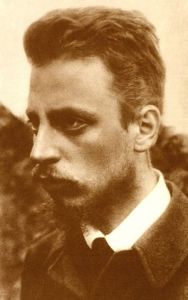
During 2015, I started a new habit: Once a day (give or take), I read a poem from famed German poet Rainer Maria Rilke. There were times when this practice really uplifted me and caused me to pause and wonder.

Rainer_Maria_Rilke,_1900

Rainer Maria Rilke, 1900, Courtesy of Wikimedia Commons

As we begin 2016, I’m going to share my six favorite Rilke writings that relate to mystery and awe. The first is below, followed by a few of my thoughts.

Continue reading

In Awe of Snowflakes

The moment one gives close attention to any thing… it becomes a mysterious, awesome, indescribably magnificent world in itself. (Henry Miller)

As I write, where I live in Minnesota, we are having our first significant snow fall of the year.

Of course, it is aggravating and scary to drive on snow and ice, and my heart breaks for those who don’t have good shelter or sufficient warmth to be comfortable in such winter weather.

At the same time, though, as I look out my living room window, I am amazed at how the snow changes the landscape into a wonderland that reminds me of a Christmas snowglobe.

And, this is just if I look at the landscape.

John O’Donohue has written that hidden beneath our initial perceptions, “another world waits.” This reminds me of something my mom told me about snow. I don’t know if this really is true, but she told me that every single snowflake is unique.

In light of this, I am so amazed by the stunning photography that PBS shared in the following link that reveals the usually hidden details of snowflakes. As Miller said, it indeed does seem true that close attention to any thing can reveal mystery and awe.

Snowflake Photography

My Favorite Awe-Inducing Video

This TED talk by Louie Schwartzberg is the best video I have found (yet) for inducing a sense of mystery and awe. It actually is framed as a talk (really a meditation) about gratitude, which shows the close connection between awe and gratitude. It would be 10 minutes well worth your time.

Thanksgiving as a Lifestyle

Soon, we Americans celebrate our most psychologically informed holiday: Thanksgiving. Although most of us associate this holiday with overeating and football, the meaning of thanksgiving is much more profound.

Most of us recognize that our thoughts often are negative in tone. Consider, for example, the thoughts to which you personally most often return. If you’re like most people, many of these thoughts probably concern what you lack, what is in the way of your progress, and what could go wrong in your future. These kinds of thoughts contribute to stress, depression, anger, anxiety, addictive behaviors, and relationship problems.

A transformation often occurs when peop learn to shift their thoughts from negative to thanksgiving. Although we only celebrate the holiday of Thanksgiving one day per year, we all would benefit from making gratitude a consistent lifestyle habit. This weekend would be the perfect opportunity to try out some new practices that might move us in the direction of cultivating a lifestyle of thanksgiving.

Some specific suggestions follow.

Continue reading