Category Archives: Psychology

Gays and the Church

Although the Supreme Court’s landmark 2015 ruling in Obergefell vs. Hodges seemed to settle many civil issues about same-sex marriage in the United States, the topic remains contentious in many religious communities. In recent years, some denominations have broken with the historical Christian view that same-sex relations “miss the mark” and have become more LGBTQ affirming. Many have not, however, meaning they will not support “unrepentant” same sex sexual behavior or same-sex marriage in their churches.

From February 23-26, 2019, another major denomination will meet to discuss its official stance about same-sex relations, as leaders in the United Methodist Church will convene in St. Louis, Missouri to discuss “a way forward.” The plan recommended by the Methodist Council of Bishops would allow local decision-makers to implement policies about matters such as same-sex marriage that best fit their social contexts. If approved, this would enable more progressive districts to support the ordination of gay and lesbian Pastors and marry same-sex couples, subject to the conscience of the local pastor, while allowing more conservative districts to remain unchanged in policy and practice.

At play in these deliberations are questions of how to know what is true about matters of faith. The founder of the Methodist tradition – John Wesley – proposed four “ways of knowing,” now organized in what is popularly termed the “Wesleyan Quadrilateral:” experience, reason, tradition, and Scripture. Basically, Methodists look for “converging evidence” in these four domains when creating church policy, although Scripture is prioritized.
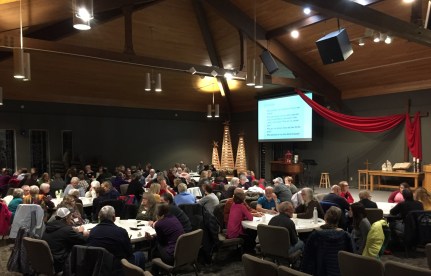
Gays_2In anticipation of the denomination’s upcoming meetings, I have led a discussion group at my local Methodist church exploring same-sex relations, using the Wesleyan Quadrilateral as an organizing tool, for the past six weeks. Members of my church community have discussed their experiences with gays and lesbians, we invited several gay Christians to our group to listen and learn from their stories, and we have explored Scripture from both conservative and progressive perspectives. As a facilitator, my charge was to lead this group neutrally, meaning I have not shared my opinion very often, I have tried to make sure the best of materials are shared from both conservative and progressive viewpoints, and I have sought to create an atmosphere that is hospitable and conducive to honest, respectful conversations among individuals who often disagree.

Continue reading

The Meaningfulness of Living with Soul

Craig is the worship leader at my church. To say his style is unique would be a great understatement.

Craig mostly plays piano and sings at church, combining a mix of folk and country with a bit of blues and funk thrown in for good measure. He is humble, but once in a while, he plays a solo, and when this becomes apparent, my wife and I glance across the aisle at each other, and smile knowingly that we are about to share a sacred moment. Whenever Craig sings his one-of-a-kind rendition of Leonard Cohen’s masterpiece “Hallelujah,” for example, tears flood our eyes. And we leave church a bit different as a result.

Craig is nearing retirement and recently pulled back from leading all three worship services, restricting himself to the early 8:00 service. His replacements are talented musicians in their own right, but many in the congregation started attending church earlier just to hear Craig play. There is just something intoxicating about his music.

The best way I can describe Craig’s music is that it is “soulfelt.”

“Soulfelt” appears in none of the major dictionaries. By this criterion, it is not a word.

But, I think it should be.

Continue reading

The Courage to Create

This past summer, I spent a glorious month teaching at “the most experimental college in North America,” Quest University Canada, north of Vancouver, British Columbia. One of my favorite aspects of Quest’s one-of-a-kind educational model is that, rather than majoring in something broad such as Business, Communications, or Psychology, students focus their work around one self-selected question. For example, one of many talented students spent her university years focused on the question of how creativity and happiness are related. As a part of a final project, she asked to interview me – along with about a dozen others – and ultimately created the short documentary below.

In this spirit, may 2019 bring you great creativity and happiness!

When Religion Promotes Violence

In a survey released last week by U. S. News and World Report, over 21,000 people from all regions of the world most commonly rated religion as the “primary source of global conflict today.” Individuals identified power, economic factors, and political beliefs less frequently.

Of course, the fact that survey respondents believe religion drives global conflict more than any other factor doesn’t mean it actually does. However, the survey does raise questions of how religion may contribute to conflict and what could be done in religions to better promote peace.

Continue reading

Religion Needs a Savior

A few weeks ago, a journalist from U. S. News & World Report called to interview me about new data showing that individuals across the world most commonly rate religion as the greatest source of global conflict today. She asked about why religion contributes so frequently to conflict and what to do about it. You know, simple questions!

Here’s the article.

It’s interesting to see how a journalist decides what to include and what not to include from a 45 minute interview. If I could summarize my take-home advice more simply, I’d say this:

1. Identify first as a fellow human.
2. Then identify with your groups.
3. If your groups don’t help you do (1), find different groups.

Six Forms of Resolution

As we begin a new year, many of us find ourselves in a bit more contemplative mood than usual. What were our highs and lows in 2017? What do we want for 2018? We all could use some clarity to live our best lives.

Sometimes, we’re waiting for clarity to strike us from the outside, maybe in the form of a sign or revelation. But more often than not, the clarity we seek is already within us, waiting to be discovered.

When I was a Sophomore in high school, I started to connect with my own unclarity. What was I going to do with my “one wild and precious life,” as Mary Oliver put it? A friend gave me a copy of Anthony Robbins’ “Awaken the Giant Within,” a book I generally now regard with great skepticism, but nonetheless that helped change my life.

Eventually, I found my way to a chapter on goal setting. Like most everyone, I had been taught I should set goals for my life. But just like how I had also been taught I should dust my room and floss my teeth, I wasn’t particularly motivated to do so. Goal setting just seemed painful, with no clear benefit. So, when I started reading the chapter, I was surprised to find a quote from Carl Sandburg: “Nothing happens unless first a dream.” I had never thought that goal setting may be more akin to dream identifying. I continued to read:

“Are you ready to have some fun? Are you willing to be like a kid again and let your imagination run wild?”

The tone caught me off guard. Maybe goal setting wasn’t like dusting my room or flossing my teeth.

I then was led on a series of tasks in which I dreamed what I wanted to create in my life. I brainstormed for 5 minutes about four areas each: personal development, career / economics, adventures, and contributions. Ultimately, I identified the most important one-year goal in each area.

The effects of this exercise on me can’t be overstated. It brought me clarity for the first time in my life. I had been a mediocre student, for instance, often struggling in difficult subjects, sometimes getting into trouble with my dad because of earning a “D.” But, during my goal setting session, I decided I wanted to be an “A” student. From that point forward, that’s exactly what I made happen. I earned straight “A”s through the rest of high school. This allowed me to enroll at the University of Wisconsin at Madison, where I continued being an “A” student. This, in part, allowed me to get into a top-rated Counseling Psychology program at the University of Minnesota. My future opened before me. And it all started with a goal.

Continue reading

The Psychology of Religion

One of my first memories happened at church. We always seemed to arrive early enough to say the rosery, but this one particular Sunday morning, my mom, brother, and I were late. We double-timed it up the concrete stairs to heave open the austere metal doors of the traditional red brick Catholic church only to find the sanctuary doors to be closed. It seemed we were not allowed entry because of our tardiness, so we were confined to a small, cold foyer filled with nothing to look at but posted advertisements for local businesses and two holy water stations. Being only 4 at the time, I quickly became bored. A hymn had started, and I snuck a peak through the closed passageway. The congregation was being led in song: “Here I am, Lord! Is it I, Lord? I have heard You calling in the night! I will go, Lord, if You lead me!…” Powerful words, I thought, and yet I observed no sign of emotion among anyone in the church. Much of the congregation didn’t even sing along.

The fact that I so clearly remember this incident reveals something about my strong religious and spiritual inclination. But the incident also raised a question for me that has become the focal point for much of my professional life: What explains why some people are more religious than others?

Continue reading

In Awe of Christmas

Christmas elicits so many emotions. For many people, these emotions are negative. There can be great loneliness, embarrassment, or shame when loved ones or traditions to share are few. There can be great sadness when memories flood our minds of loved ones no longer with us to celebrate.

What makes Christmas “the most wonderful time of the year” for many others is the glow of positivity surrounding the holiday. For me personally, I remember the excitement of opening presents when I was young – and how my anticipation led me to hunt for where they might be hidden, and lose sleep the night before having the opportunity to open them. Holiday lights, Christmas cookies, mulled wine, pageants, and concerts all fill me with cozy feelings laced with history. Looking through the cards we have received thus far this year, I am struck by references to “joy,” “peace,” “love,” “cheer,” and “merriness.”

A couple of years ago, though, I had an experience that changed the way I think about the meaning of Christmas. I was attending a Christmas Eve service at a church that my family and I had recently started attending. The service was organized differently from what I had expected, with alternating readings and songs.

Continue reading