Sometimes, after dinner, the dishes washed and the kitchen reasonably cleaned, a window of time opens. My family disperses into their various corners of our home, allowing me to settle into the living room. I switch into comfortable clothing and I wrap myself in the soft, oversized blanket my wife gave me for Christmas.
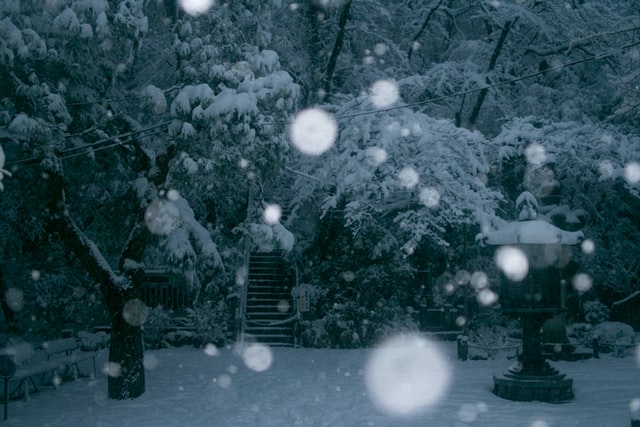
Tonight, I look outside, into the darkness, where the only light comes from the faint glow off the newly fallen snow. I listen to the breeze shaking the trees, rattling the house, causing the chimney to whistle.
Unsplash | Takemaru Hirai
During an awful pandemic that mostly restricts, in the midst of a Minnesota January, freedom can sometimes be found. There are options for what to do I don’t remember always having.
There are times when I light a fire in the fireplace and drink some herbal tea before settling into some pleasure reading, writing, or Netflix. Occasionally, a family member joins me for a game of Yahtzee or Quirkle. Some nights I go upstairs and settle into my tub, surrounded by candles, smells of lavender, and classical music played by Alexa.
In the past, I probably would have interpreted these unstructured, unplanned, unexciting nights as “boring.” However, I’m now finding power in reframing them as opportunities to “settle.”
One of the fresh perspectives I’ve appreciated this year is that of Sikh activist, best-selling author, and popular TED talk speaker, Valarie Kaur. A few months ago, on Twitter, Kaur asked:
“Over the course of [this year], what have you discovered is most essential to YOU?”
I posed this question (virtually) last week to a group of students I help lead through a Christian student club on my campus, and their responses were thoughtful. “Time outside in nature,” one said. “Being able to easily and physically spend time with family and friends,” said another. “Or just brief interactions with strangers at the store,” I added. “Hugs,” someone said, before following up by saying “and things to do outside the house.” “Moving my body,” added someone else. “Knowing that I am not in control and that I need a source I can ultimately trust,” reflected another.
Sometimes, what is most essential is what we have long taken for granted.
Unsplash | Ben White
As Frederick Buechner once said:
“Listen to your life. See it for the fathomless mystery that it is. In the boredom and pain of it no less than in the excitement and gladness: touch, taste, smell your way to the holy and hidden heart of it, because in the last analysis all moments are key moments, and life itself is grace.”
The year 2020 was not a wasted year. It was a year ripe for listening to our life experience. May we learn from our life and intentionally create something new and better – for ourselves and our communities – in 2021.
It’s been quite a year. With all the losses of 2020, one plus has been more time for me to write. Many new people started reading and following the blog this year, and for the first time, I’ve published several excellent guest blogger’s posts. Along with everyone else, the COVID pandemic was top of mind for me, and that was reflected in the themes of my writing.
As a way to review this year, below are the top posts of 2020 on this blog. If you haven’t had a chance to read these articles yet, this might be an interesting time to do so.
This is a personal confession with some of my struggles with church and religion, in light of new research published this year on people who are “done.”
This was, by far, the most popular post on the blog this year. It revisits themes of posts I wrote years ago, but seemed to find new popularity – particularly in South Africa – in light of students made to learn at home.
***
Unsplash | Immo Wegmann
Reviewing this year in writing like this makes me wonder about what themes and developments will arise in 2021. Hopefully one of hope!
In the Christian calander, Advent refers to the four Sundays and weeks leading up to the celebration of Christmas. In Latin, Advent means “coming,” and this season provides a window in time for Christians to intentionally dwell in a spirit of longing, hope, and patient waiting and anticipation. In a year of public health crisis, financial and work uncertainty, racial unrest, and political strife, this emphasis strikes a new resonance in our life experience and has the potential to impact us more powerfully than in the past.
As I seek to understand and live out my faith, I find I become consumed, from time to time, with different perspectives and voices. As I look on my bookshelves, for example, I am fondly reminded of times where I have been enamored by the insights of Frederick Buechner, Shane Claiborne, Kathleen Norris, Parker Palmer, Barbara Brown Taylor, and, of course, C. S. Lewis, among others. Recently, I have acquired a new hero: Kate Bowler.
Kate Bowler
Kate has put out a free Advent devotional, and I find I am profoundly drawn in by her thoughts, as she so beautifully and compellingly connects traditional Christian faith with the suffering of this year and this moment. Part of this ability surely stems from her own experience and struggle with as someone who suffers as a stage IV cancer patient, (which she discusses in her amazing TED talk). For example, in the “liturgy” she shared today, Kate invites us to pray:
“blessed are we with eyes open to see the suffering from pandemic danger, sickness and loneliness, the injustice of racial oppression, the unimpeded greed and misuse of power, violence, intimidation, and use of dominance for its own sake, the mockery of truth, and disdain for weakness or vulnerability, and worse, the seeming powerlessness of anyone trying to stop it.
blessed are we who despair for our democracy, and ask: what can we do to protect it?
blessed are we who ask: where are you God? and where are Your people the smart, sane, and sensible ones who fight for good?”
***
As I meditate on these words, I am stunned by the realization of how much pain this year I have consciously or unconsciously tried to suppress. I feel my perspective broadened and made more whole by inviting and welcoming “eyes to see” those who are sick, lonely, and oppressed. I recognize, afresh, the extent to which truth, weakness, and vulnerability are being mocked, and how that makes all the problems we’re facing worse. I appreciate the despairing concern for our democracy and world. And, I agonize over why “God’s people” so often are part of these problems, and why they are not more often involved in the fight for good.
This prayer validates my experience and urges me to have more empathy for those who are struggling right now and do what I can to help. As Kate concludes her “liturgy,” it builds a conviction to “take hold of hope, as protest.”
As we look toward Christmas this year, we do so with a realization that God doesn’t shy away from awfulness (like I tend to do). In fact, God enters in vulnerably – rejected, in the midst of a genocide, and in the humble form of a baby. Emmanuel remains with us, in suffering, and God calls us to be present, in suffering, as well.
Last week, I stumbled upon an opportunity to join a Zoom book club in South Africa in which famed Yale theologian, Miroslav Volf, agreed to participate. I’ve admired Volf for years, beginning with this interview in which he expounds upon some of his ideas about religion, genocide, and violence. I ultimately featured many of his insights in this piece I wrote about Christianity and the Holocaust.
To my surprise and delight, there were only a handful of people in the zoom call, which gave me stunning access to Volf. My daughter joined me over lunch, and we ended up discussing themes raised related to Christianity, genocide, racism, and social justice.
Miroslav Volf
What most struck me during this discussion was a comment Volf made, in passing, which I paraphrase to the best of my memory here: “Every time I post to social media, I pray: ‘Lord, make me an instrument of your peace.‘” The thought was that, if the message to be sent didn’t line up with this prayer, Volf would change it, but if it did line up, the prayer was for the message to have this intended effect.
“The higher goal of spiritual living is not to amass a wealth of information, but to face sacred moments.” (Rabbi Abraham Joshua Heschel)
***
The year 2020 will go down in history as a year of public health, economic, and societal crisis. Much less acknowledged, however, is the profound emotional and spiritual malaise* many people feel. In fact, in the United States, emotional distress is three times higher than previous years and happiness is at a near 50-year low.
For many of us, something seems “off.” Perhaps this feels like a sense that something is vaguely “missing,” or maybe we “long” for something more or different. Probably many of us have grown “numb” to these feelings over the past several months – without fully realizing it. We may not understand why we’re feeling the way we do or appreciate how much our inner lives really have changed.
***
It’s with all this in mind that I’ve been reflecting on some new research published this week in the journal Psychology of Religion and Spirituality.
In this study, 2,889 participants were asked about the frequency with which they generally experience “sacred moments” in their everyday lives. Specifically, individuals were instructed to rate, on a scale of 1 (never / not at all) to 5 (very often), how often they experience:
“a moment that felt set apart from everyday life,”
“a moment… that was really real,”
“a moment in which all distractions seemed to melt away,”
“a deep sense of connection with someone or something,”
“a sense of uplift,” and
“a sacred moment.”
Results from this research show that individuals’ experiences of sacred moments predicted “higher levels of positive emotions and greater presence of meaning, as well as lower levels of perceived stress, depressed distress, and anxious distress.”
***
What is it about “sacred moments,” as defined and measured in the above study, that might be most essential, that might be most involved in predicting higher well-being? When I consider the scale items mentioned above, the one that stands out most focuses on moments of deep “connection with someone or something.” I imagine that deep experiences of connection drive the sense that moments feel “set apart from everyday life” and “really real,” for instance.
My core identity remains deeply Christian. However, after 48 years of attending church at least once per week (almost without exception, even during college), I am – at least temporarily – “done” with the local church.
Part of this stems from the era of COVID-19. At the same time my family and I try to do what we feel is responsible in preventing further spread of the virus, others in our area see no problem with in-person worship, contributing to a new sense of disconnection.
Even if COVID-19 never happened, though, I still might be “done.” For years, although I earnestly joined with others in my local church community to recite the same creed and prayers of the Christian faith and to pour my heart into collective worship and service, I often – ironically enough – had the sense we didn’t share the same worldview or many of the same values. I never felt comfortable attending the men’s Bible study because I believed my questions or divergent thoughts would not be welcome. Maybe this is an aside – or maybe not – but my kids never significantly connected with anyone in the church’s youth program either. As time passed, I realized we didn’t really have a place at that table.
I’m not happy about being “done.” I feel failure… isolation… and profound loss. I’ve described this split as being like “divorce.” And, yet, in my brokenness, I also feel some degree of new freedom.
***
The first time I heard of a religious “done” was when I was in a meeting with my colleague, Josh Packard, Sociologist at the University of Northern Colorado, Executive Director of Springtide Research Institute, and author of “Church refugees: Sociologists reveal with people are DONE with church but not their faith.” The term “done” is a play on words, referencing the more common term religious “nones,” the broader, growing group of individuals in the developed world who express no religious affiliation.
For anyone who regularly reads this blog, you might remember me writing a post in March of this year about C. S. Lewis’s essay “On Living in an Atomic Age,” from his book “Present Concerns.” As it’s become clearer to me that COVID-19 – particularly in the United States – is likely to continue to be a source of concern well into next year, and as my family increasingly exposes itself to the risk of contracting the virus (especially as school opens), I’ve continued to reflect on this essay as a way to come to terms with my feelings of anxiety.
Although I recognize the atomic bomb has substantially greater risk to humanity than COVID-19, I’m going to take the liberty to replace Lewis’s references to the atomic bomb with references to the COVID-19 pandemic to make the connections as clear as possible:
“In one way we think a great deal too much about COVID-19. ‘How are we to live in an age of pandemic?’ I am tempted to reply: ‘Why, as you would have lived in the sixteenth century when the plague visited London almost every year, or as you would have lived in a Viking age when raiders from Scandinavia might land and cut your throat any night…
In other words, do not let us begin by exaggerating the novelty of our situation. Believe me, dear sir or madam, you and all whom you love were already sentenced to death before COVID: and quite a high percentage of us were going to die in unpleasant ways… It is perfectly ridiculous to go about whimpering and drawing long faces because the scientists have added one more chance of painful and premature death to a world which already bristled with such chances and in which death itself was not a chance at all, but a certainty.
This is the first point to be made: and the first action to be taken is to pull ourselves together. If we are going to catch COVID, let the virus when it finds us doing sensible and human things… Disease may break our bodies, but it need not dominate our minds…
What the wars and the weather… and COVID have really done is remind us forcibly of the sort of world we are living in and which… we were beginning to forget. And this reminder is, so far as it goes, a good thing. We have been waked from a pretty dream, and now we can begin to talk about realities.”
There are three main insights I gain from this.
First is one of radical acceptance. In addition to the painful consequences of racism and job / financial insecurity that this year has brought to the forefront of our minds, COVID-19 teaches us how this world is broken.
This leads to a second realization, that I am in a state of mourning. And, I’m not the only one. In fact, Michelle Obama recently labelled her experience “low-grade depression.” I personally wouldn’t go that far, but there is a sense of loss I feel this year with my realization of the true state of the world. The more people I talk to about the state of the world, the more common I believe many people are grieving.
When people ask me how I’m doing in this time of “shelter-in-place,” I sometimes will make an attempt at humor and respond: “I’ve always thought I could have been a monk.”
I’ve long been intrigued by monks and by monastic living.
Whenever I’ve had the opportunity, I’ve tried to learn what I can about monks and monastic living and to incorporate those insights into my daily life. Many years ago, for instance, I participated in the sunrise chants of the Benedictine monks living at St. John’s Abbey in Collegeville, Minnesota, and this taught me something about the vitality of intentional prayer, particularly early in the morning. Since it aired 13 years ago, this On Being interview with Shane Claiborne about “a monastic revolution” has challenged me to be a “real Christian” and follow the sometimes very straightforward and radical teachings of Jesus. Similarly, I’ve been struck by this publication of “the Monk Manifesto” a few years ago, particularly principle #3: “I commit to cultivating community by finding kindred spirits along the path, soul friends with whom I can share my deepest longings, and mentors who can offer guidance and wisdom for the journey.”
As I think about this, I wonder if part of the challenge many of us are facing right now is this: we’re living sort of like monks as we “shelter-in-place,” but without the knowledge of tradition, support, or intentionality that typically comes with monastic living.
If you guessed the 18-29 year-olds, you’d be correct.
In a recent nationally representative survey, 69% of 18-29 year-olds reported being lonely or isolated in the last 7 days (59% of 30-49 year-olds reported this, as did 45% of 50-64 year-olds and 39% of those ages 65+).
Of course, this isn’t a competition, and we who call ourselves Christians – and we who call ourselves compassionate humans – seek to care for those in need no matter the age or background. Still, I bet not many would guess that young people are those most struggling with feelings of loneliness or social isolation during this pandemic.
In another nationally representative survey, 66% of 18-25 year-olds said they had no one to talk to about these feelings. And, 80% felt better when a trusted adult outside their household reached out to them.
Do you know a young person – outside your household – you might connect with? Maybe a child, grandchild, niece, nephew, member of your community, or someone you barely know but feel like might be struggling?
A call, text, Facetime, or care package dropped off at their front door might mean more than you realize.


 Andy Tix