Category Archives: Current Events

The Religious Language of Republicans and Democrats

Note: It’s my honor and joy that my former student, Whitney Harper, guest authored the post below. Whitney was a student of mine when I taught in Scotland in 2009, and we have remained close ever since. She now is a Ph.D. candidate in Theology at Katholieke Universiteit Leuven in Belgium.

***

In the United States we like to claim separation of church and state, but the reality is much more complicated. Although our minds may automatically be drawn to the Religious Right as the main violator of this separation, research has shown Democratic candidates have taken note, and are also making use of religious language to frame their stances.

In contrast to Republican candidates’ overt use of religious language to frame debates surrounding abortion, Christianity’s role in the public sphere, and “family values,” Democratic candidates tend to take a more subtle approach, being careful not to alienate non-Christian voters, but also making sure to use phrases that will perk up the ears of Christians. They tend to use religious language to frame care for the poor, healthcare reform, and concern for racism, sexism, and the environment; often centering their religious rhetoric on Jesus’ petition to care for “the least of these.” Although these references aren’t as explicit as Republicans,’ they have started to persuade more Christian voters to the Democratic Party, building up the more recently established “Religious Left.”

How has religious language been so successful not only in the Republican Party, but also in a party that has largely taken a more “secular” stance? Recent research can be especially helpful in answering this question.

A body of psychological research consistently shows that voters make their decisions primarily based on a “gut” feeling, and that religious language is especially helpful for speaking to this intuitive sense. For example, in his book The Righteous Mind, social psychologist Jonathan Haidt examines moral intuitions in relation to religion and politics in the United States. He argues that, when it comes to religion and politics – and really any of our decision-making – “intuitions come first, strategic reasoning second” (italics in the original). By this, Haidt means that as much as people want to believe they make decisions rationally and consciously, the reality is that almost all of our reasoning is unconscious and driven by instinct and emotion. He elaborates:

“The central metaphor . . . is that the mind is divided, like a rider on an elephant, and the rider’s job is to serve the elephant. The rider is our conscious reasoning – the stream of words and images of which we are fully aware. The elephant is the other 99 percent of mental processes – the ones that occur outside of awareness but that actually govern most of our behavior” (italics in the original).

In other words, most of the choices we make – including how religious we are, who we vote for, and how we make moral decisions – are driven by emotion. We then create reasons and justifications after the fact. We feel to our very core our beliefs are the correct ones – to the point that words can’t fully explain why, as much as we may try – and this strong urge makes it easier to dismiss other views. This is what psychologists call the confirmation bias: the act of ignoring information that contradicts what we already think and seeking out information that reaffirms what we already believe.

This strong emotional gut-level reaction is what makes the coupling of religious and political language so powerful in a voter’s decision making. For example, for several decades the pro-life stance has been drilled into the majority of conservative Christians’ minds as the stance for Christians to look for when voting. Over time, this has strengthened Christian voters’ instinctive responses to “pro-life” language. Haidt continues:

Unsplash | Brad Dodson
Continue reading

The Emotional Benefits of Sacred Moments

“The higher goal of spiritual living is not to amass a wealth of information, but to face sacred moments.” (Rabbi Abraham Joshua Heschel)

***

The year 2020 will go down in history as a year of public health, economic, and societal crisis. Much less acknowledged, however, is the profound emotional and spiritual malaise* many people feel. In fact, in the United States, emotional distress is three times higher than previous years and happiness is at a near 50-year low.

For many of us, something seems “off.” Perhaps this feels like a sense that something is vaguely “missing,” or maybe we “long” for something more or different. Probably many of us have grown “numb” to these feelings over the past several months – without fully realizing it. We may not understand why we’re feeling the way we do or appreciate how much our inner lives really have changed.

***

It’s with all this in mind that I’ve been reflecting on some new research published this week in the journal Psychology of Religion and Spirituality.

In this study, 2,889 participants were asked about the frequency with which they generally experience “sacred moments” in their everyday lives. Specifically, individuals were instructed to rate, on a scale of 1 (never / not at all) to 5 (very often), how often they experience:

  • “a moment that felt set apart from everyday life,”
  • “a moment… that was really real,”
  • “a moment in which all distractions seemed to melt away,”
  • “a deep sense of connection with someone or something,”
  • “a sense of uplift,” and
  • “a sacred moment.”

Results from this research show that individuals’ experiences of sacred moments predicted “higher levels of positive emotions and greater presence of meaning, as well as lower levels of perceived stress, depressed distress, and anxious distress.”  

***

What is it about “sacred moments,” as defined and measured in the above study, that might be most essential, that might be most involved in predicting higher well-being? When I consider the scale items mentioned above, the one that stands out most focuses on moments of deep “connection with someone or something.” I imagine that deep experiences of connection drive the sense that moments feel “set apart from everyday life” and “really real,” for instance.

Continue reading

COVID-19 is a Self-Fulfilling Prophecy

A self-fulfilling prophecy is a process by which expectations elicit behaviors that ultimately confirm those expectations. For instance, many psychologists discuss how stock market trading can be influenced by a self-fulfilling prophecy. When individuals believe the stock market is going to rise, they buy, and the stock market does rise; when people believe the market is going to fall, they sell, and the market does fall.

The COVID-19 pandemic may demonstrate many more examples of the self-fulfilling prophecy. For example, many individuals believe there’s nothing that can be done to prevent the spread of the virus and that everyone’s going to become infected at some point no matter what. Such people may argue that lockdowns, social distancing, and masks don’t make any significant difference, and this may lead them to argue for re-opening, go to bars, and not wear masks. And, when enough individuals demonstrate this pattern, the virus does spread, as it has in many regions of the United States.

How will similar self-fulfilling prophecies impact what happens this academic year as elementary, secondary, and post-secondary students return to school? Some say that elementary school children can’t possibly wear masks during an entire school day. Many argue that middle-school and high-school kids can’t possibly control their bodies and remain physically distant from their peers. Others are convinced that college and university students will, of course, go to bars and party. Across these levels of school, many believe that the quality of education will definitely be lacking. We may be in for a very difficult fall and winter if these are the assumptions that guide us.

There actually is a great deal of controversy and debate among researchers who study the self-fulfilling prophecy: maybe self-fulfilling prophecies elicit certain outcomes because people’s expectations are accurate in the first place. For instance, it’s true that students experience certain struggles conforming to public health guidelines because of developmental needs and that following these guidelines is particularly difficult for some due to various underlying conditions. There definitely are unique obstacles for education during a pandemic.

This raises a key question about people’s mindsets, with potentially critical consequences for this pandemic: do we emphasize limitations and obstacles in our thinking and assume that behavior cannot change, or do we emphasize possibilities and assume that behavior can change through effort, persistence, and accurate information? In some ways, the answer surely depends on the individual and situation. We need to be real. At the same time, what if we lean optimistic this academic year and assume that young people are capable of social responsibility and that schools can be a spark for transformation?

Pexels | Gustavo Fring

Pexels | Gustavo Fring

Continue reading

On Living in the Age of COVID-19

For anyone who regularly reads this blog, you might remember me writing a post in March of this year about C. S. Lewis’s essay “On Living in an Atomic Age,” from his book “Present Concerns.” As it’s become clearer to me that COVID-19 – particularly in the United States – is likely to continue to be a source of concern well into next year, and as my family increasingly exposes itself to the risk of contracting the virus (especially as school opens), I’ve continued to reflect on this essay as a way to come to terms with my feelings of anxiety.

Although I recognize the atomic bomb has substantially greater risk to humanity than COVID-19, I’m going to take the liberty to replace Lewis’s references to the atomic bomb with references to the COVID-19 pandemic to make the connections as clear as possible:

“In one way we think a great deal too much about COVID-19. ‘How are we to live in an age of pandemic?’ I am tempted to reply: ‘Why, as you would have lived in the sixteenth century when the plague visited London almost every year, or as you would have lived in a Viking age when raiders from Scandinavia might land and cut your throat any night… 

In other words, do not let us begin by exaggerating the novelty of our situation. Believe me, dear sir or madam, you and all whom you love were already sentenced to death before COVID: and quite a high percentage of us were going to die in unpleasant ways… It is perfectly ridiculous to go about whimpering and drawing long faces because the scientists have added one more chance of painful and premature death to a world which already bristled with such chances and in which death itself was not a chance at all, but a certainty.

This is the first point to be made: and the first action to be taken is to pull ourselves together. If we are going to catch COVID, let the virus when it finds us doing sensible and human things… Disease may break our bodies, but it need not dominate our minds…

What the wars and the weather… and COVID have really done is remind us forcibly of the sort of world we are living in and which… we were beginning to forget. And this reminder is, so far as it goes, a good thing. We have been waked from a pretty dream, and now we can begin to talk about realities.”

There are three main insights I gain from this.

First is one of radical acceptance. In addition to the painful consequences of racism and job / financial insecurity that this year has brought to the forefront of our minds, COVID-19 teaches us how this world is broken.

This leads to a second realization, that I am in a state of mourning. And, I’m not the only one. In fact, Michelle Obama recently labelled her experience “low-grade depression.” I personally wouldn’t go that far, but there is a sense of loss I feel this year with my realization of the true state of the world. The more people I talk to about the state of the world, the more common I believe many people are grieving.

Continue reading

Three Updates to Psychology Courses for Fall, 2020

According to the most recent data available, approximately 30% of American high school students take a course in Psychology. In addition, approximately 1.2-1.6 million American students take an Introductory Psychology course in college every year.

To the extent we have control over our curriculum, we who teach Psychology courses have a unique opportunity and responsibility during the fall of 2020: we can help educate a significant slice of American youth about some of the behavioral and psychological aspects of the great challenges defining this time. We can encourage greater insight and inspire prosocial change.

Below are three topics we can integrate into our fall courses that are particularly timely and important, with some suggestions for how to do so.

Julia Cameron Pexels 2

1. The psychology of group behavior.

COVID-19 spreads through droplets, yes, but those droplets spread from person to person through specific behaviors. Racial inequality is systemic, yes, but systems stem from, and are maintained, by specific behaviors. Climate change is a widely considered a “threat multiplier,” a meta-problem that increases the likelihood of pandemics and many other social problems; it also is caused by specific behaviors.

We teachers of Psychology can focus on individual differences in behavior and why individuals do what they do, and each of the above problems can be fruitfully explored from this level of analysis. However, if there ever was a time to explore the psychology of group behavior, this is it, as each of the above current problems also demonstrates how behavior is powerfully determined by the norms of individuals’ groups.

Continue reading

The Stories We Tell Ourselves About Race

Like so many, I’ve been thinking a lot lately about race relations, particularly in my community. The death of George Floyd shocked so many of us, myself obviously included. It’s been difficult to know how to respond.

One response we as a family felt strongly about was to visit the site of the killing as well as the site of the major rioting, so that we could discuss race intentionally for at least a morning. This isn’t sufficient, of course, but it is a continuation and recommitment for us. Visiting places I’ve hung out at my whole life – but seeing it transformed in the aftermath of a now global event – was surreal. It was eerily quiet. Sacred.

IMG_3136

More recently, my friend and former student, Whitney Harper, approached me with the idea for a blog entry for Psychology Today. We published it today, and you can find it below. There’s so much more to say, but here are some of our thoughts.

***

“You might think that the world is made of atoms, but the world and, in particular, human history and the moment we’re living right now, is made out of stories.”

-John Powell, Director of the Othering & Belonging Institute at UC-Berkeley, as quoted in a recent episode of the Science of Happiness podcast

An increasing body of research shows how central narratives are to human experience. We all create stories to make sense of experience, and these stories go on to determine how we frame our lives, our contexts, and our decisions about the future. When we encounter a person or situation, we intuitively interpret and narrate as we place this person or situation in the context of past experiences, making connections and judgments automatically. For example, when I interact with a man in his 20’s who is wearing boat shoes and pastel clothing, I have a certain narrative framework that gets triggered about what his background might be, what he does with his free time, and how he feels about certain political issues – stories and stereotypes that have been (rightly or wrongly) constructed and associated with these fashion choices.

Narrative theory goes beyond analyzing automatic associations, though, and also helps us make sense of larger, complex stories of past, present, and future. For example, when I (Whitney) am in a fight with my sister, I understand our current conflict within a wider narrative. I know from the past that we need to take space and cool off because we both got this wonderful trait from our dad that makes it so we have to have the last word; I know from the present what is going on in each of our lives and what else is weighing on us and on our relationship; and I know that no matter what, I do not want to lose our future relationship (regardless of how wrong I think she is).

Narrative theory also looks at interactions between people as inherently situated within the larger structures of society. For instance, my relationship with my sister is also informed by the narratives of what being “sisters” and “family” mean – narratives that can change and take on different meanings across cultures, and that have been built up across history. Of course, in the middle of fighting, I may not think about the layers of narratives that play into it (I often am much more focused on my next response and how I can shut my sister down) – but the point is that this complex history of being sisters deeply impacts my current interactions.

Similarly, narrative theory can help us make some sense of the multi-layered, complex narratives surrounding race relations in the United States today. When we address racial inequality in the United States, we often frame these discussions in terms of “racist” vs. “not racist” or “color-blind,” but research points to how reality is much more complicated than these labels allow for, and shows that the racialized frameworks developed throughout our history continue to frame our interactions today even in situations where we have little to no awareness of their impact. When we become more aware, changing these narratives becomes more possible.

As Chimamanda Adichie explains in her TED talk, “The Danger of a Single Story,” it matters greatly where we begin our stories. If we begin to tell the story of race with the Black man we see on the news who was brought into custody because of armed robbery, we arrive at one perspective. If our story of race begins with the recent police violence and the arrest of George Floyd, we arrive at another perspective. But, imagine if we recognize the history of race in America, and begin the story with colonialism, slavery, or hundreds of years of frustration among people of color in the United States. We gain a completely different and potentially more grounded and contextualized perspective, one that helps us make better sense of why a white police officer, with knowledge that he is being filmed, kills a Black man in broad daylight with seemingly little to no fear of repercussions.

Continue reading

What If We’re Not Waging “War” Against COVID-19?

As the number of cases of COVID-19 continues to increase in our region, I continue to think of this excellent article from Christian Century. It challenges the presumption that the most productive metaphor for what we’re doing as a society is “waging war against the virus,” and instead raises some very thought-provoking questions:

christopher-sardegna-CMOa3H1SXG0-unsplash

Christopher Sardegna | Unsplash

“What will it mean for our country and world to live well with this pandemic?”

“Will we be patient and kind?”

Will we be able to truthfully accept and faithfully bear this tragedy, even as we try to conquer it?”

“How will we care for those who cannot be cured – a question made painfully difficult by the six or more feet of space that separates the dying from their families?”

“How well will we grieve – privately in our own homes, locally in shifts of ten, and collectively as a human race?”

Is Mental Health a Valid Reason to Not Socially Distance?

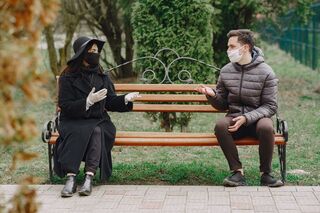
Even as public health experts and government authorities continue to advocate for physical distancing to minimize the spread of COVID-19, compliance appears to be diminishing. For example, mobile phone data across the United States reveals trends, beginning toward the end of April, of individuals spending more time away from their homes.

Of the many reasons why individuals may not comply with physical distancing guidelines, concerns about mental health may be most prominent. A Gallup poll conducted in April, for instance, indicated how emotional and mental health seemed to be the strongest consideration for individuals maintaining distancing, as compared with concerns about physical health and financial hardship.

united-nations-covid-19-response-IKyhoO8giSA-unsplash_rev

United Nations COVID-19 Response | Unsplash

The pandemic clearly is not just a crisis for physical health and the medical system; it also is an enormous challenge for mental health and the mental health system. New data released over this past weekend by Jean Twenge hints at the magnitude of these problems. In her survey conducted on April 27th, Twenge asked U. S. adults how sad or nervous they felt and compared those responses with demographically similar adults who answered the same questions in 2018. She found that roughly 70% of Americans demonstrate “moderate to severe” mental distress now, during the pandemic, a rate three times that reported in 2018. Young people show the greatest distress, a group other research has also found to be most socially isolated.

And yet, even as these problems become more evident, no major mental health organization – such as the American Psychological Association (APA) – publicly opposes physical distancing guidelines. Instead, mental health and behavioral experts point to ways to maintain distancing while at the same time attending to individuals’ mental health.

Continue reading

Lessons from the Monks for the COVID-19 Pandemic

When people ask me how I’m doing in this time of “shelter-in-place,” I sometimes will make an attempt at humor and respond: “I’ve always thought I could have been a monk.” 

I’ve long been intrigued by monks and by monastic living.

Whenever I’ve had the opportunity, I’ve tried to learn what I can about monks and monastic living and to incorporate those insights into my daily life. Many years ago, for instance, I participated in the sunrise chants of the Benedictine monks living at St. John’s Abbey in Collegeville, Minnesota, and this taught me something about the vitality of intentional prayer, particularly early in the morning. Since it aired 13 years ago, this On Being interview with Shane Claiborne about “a monastic revolution” has challenged me to be a “real Christian” and follow the sometimes very straightforward and radical teachings of Jesus. Similarly, I’ve been struck by this publication of “the Monk Manifesto” a few years ago, particularly principle #3: “I commit to cultivating community by finding kindred spirits along the path, soul friends with whom I can share my deepest longings, and mentors who can offer guidance and wisdom for the journey.”

As I think about this, I wonder if part of the challenge many of us are facing right now is this: we’re living sort of like monks as we “shelter-in-place,” but without the knowledge of tradition, support, or intentionality that typically comes with monastic living. 

Continue reading

The Most Lonely and Isolated

Which of the following groups do you believe, in the last 7 days, have felt most lonely or isolated?

-Those aged 18-29
-Those aged 30-49
-Those aged 50-64
-Those aged 65+

If you guessed the 18-29 year-olds, you’d be correct.

In a recent nationally representative survey, 69% of 18-29 year-olds reported being lonely or isolated in the last 7 days (59% of 30-49 year-olds reported this, as did 45% of 50-64 year-olds and 39% of those ages 65+).

Of course, this isn’t a competition, and we who call ourselves Christians – and we who call ourselves compassionate humans – seek to care for those in need no matter the age or background. Still, I bet not many would guess that young people are those most struggling with feelings of loneliness or social isolation during this pandemic.

In another nationally representative survey, 66% of 18-25 year-olds said they had no one to talk to about these feelings. And, 80% felt better when a trusted adult outside their household reached out to them.

Do you know a young person – outside your household – you might connect with? Maybe a child, grandchild, niece, nephew, member of your community, or someone you barely know but feel like might be struggling?

A call, text, Facetime, or care package dropped off at their front door might mean more than you realize.