The challenges of this time humble me as a science writer and educator. As I participate in discussions about many of the most serious and pressing problems now facing our country and world – problems ranging from vaccine hesitancy to racism, from race relations to climate change – one overarching meta-problem frequently recurs. Coming from different universes of information and social comparison, we don’t agree on the relevant facts.
Theodore Parker once stated that facts are “true, independent of all human opinion.” That is, although we may have wishes for what’s true, previous beliefs about what’s true, and groups telling us what’s true, none of this compares with what’s actually true. Reality has a life of its own.
In the past, we could at least sometimes come together as a people, even if we disagreed on initial solutions to problems, because we agreed on relevant facts. This has largely changed. As a result, we are increasingly polarized and fractured, often incapable of consensus, compromise, civil discourse, and creative problem-solving.
One of the purposes of education is to prepare us to be able to separate fact from fiction. Since many of the problems noted above concern questions about how the world works, science education, in particular, seems at least partly to blame.
What do we need to be able to do to think critically, especially in the scientific realm, as we wrestle with the problems of this time? Below are six essential skills we need as citizens, at least as a start.
As my wife and I walked from the front doors to the worship center of the exponentially growing church we used to attend in the mid-1990s, we often remarked how much relational tension filled the hallways. Young couples frequently walked together in silence, their faces sometimes providing brief glimpses of the irritation they felt toward each other. Moms and dads regularly yelled at kids to get them to Sunday school. Friends and acquaintances mostly kept to themselves.
People had good reason for waking up early on a Sunday morning to pack the auditorium. The young preacher challenged us with mind-stretching insights that directly applied to our lives. The band led us into worship experiences that connected us with God in ways that melted our selves into something larger.
During these times of shared praise, in particular, emotion poured out of many. I often cried during songs, for example, tears pouring down my face. Sometimes, I’d be unable to continue singing, in fact, feeling so “choked up.” There were even a few times when I felt so overwhelmed I had to physically brace myself with the chair in front of me because I was literally “weak in the knees.”
When we left the worship space, my wife and I frequently commented how those around us seemed palpably different than when they arrived. Not everything was perfect, of course, but tension had lifted. Young couples looked more in love, holding hands on their way out the door. Families played. Others welcomed conversation over coffee and donuts.
If this had been a one-time occurrence, I may not have thought much of it. But, it was so predictable, it was almost comical. Pretty much every week, the same basic story unfolded: people were being transformed.
Maybe the most notable observation we made, though, at least in retrospect, occurred when we left the church building and walked back to our car. The parking lot typically was much fuller than when we arrived, and we often were struck by the range of political bumper stickers. Frequently, we’d see people part ways in the parking lot with a handshake or hug, only to enter cars with stickers suggesting different political affiliations.
As a young Ph.D. student studying Psychology at the University of Minnesota at the time, I wondered: what might help account for the powerful positive effects we were observing? Nothing in psychological science seemed capable of providing a good explanation.
“The source of all sorrow is the illusion that of ourselves we are anything but dust.” (Thomas Merton)
On this Ash Wednesday – in the middle of a pandemic, where COVID deaths in the United States now easily surpass the number of American deaths in World War II – Merton’s words ring particulalry true. I don’t remember a year where my soul has been more ready for the 40+ day season of intentional contemplation that is Lent.
Remembering today that I am made of dust – and to dust I shall return – reminds me how often I cling to earthy attachments, and how this brings with it great suffering. The admonition of St. Ignatius to “hold things lightly” also comes to mind.
My tendency is to skip past Ash Wednesday, to quickly divert myself to my longing for more, for hope, for Easter. This year, I’d rather learn to sit in the tension, in the reality of hardship, to not push these feelings away, and to realize this is a vital part of being human as well.
Before this year, from December to March, I spent most of my adult life inside. During these months in Minnesota, where I live, high temperatures typically remain below freezing, and it’s not uncommon to wake up to a reading of below 0 degrees Fahrenheit, not counting “wind chill.”
Although I intentionally exercised several times per week, much of this time in previous years was passed in my gym where I watched old episodes of Friends while artificially bounding on an elliptical machine. This felt easier. When I considered going outside, images came to mind of my whole body shivering uncontrollably, my face becoming numb, my fingers and toes feeling like they might be seriously frostbitten, my nostril hairs freezing as I breathed in the cold, dry air.
With COVID-19 cases surging as we entered the winter months this year, I faced a clear choice: (1) continue the comfortable routine of previous years by working out inside my gym, knowing this would mean I would more likely contract and spread the virus, or (2) extend my summer and fall habits of exercising in the great outdoors. Favoring public health, I decided on the latter: I put my gym membership on temporary hold, and with some trepidation, I planned for a winter of outdoor adventure.
I’m now a few months into this new lifestyle. Some days, I walk or hike on paths near my home, aided by the most marvelous invention I never knew to keep myself from falling on the snow and ice: Yaktrax. Other days, when I have more flexibility in my schedule, I practice my classic ski technique at a local park or snowshoe along the pine tree-lined trails of my favorite local nature center. Weekends provide opportunities for more extended travel or adventure, such as half-day trips to formerly unexplored or underexplored Minnesota State Parks.
A few insights have been essential to making this work. First, I have new appreciation for the Scandinavian saying: “there’s no such thing as bad temperature, only bad clothing.” Although it was an investment, purchasing high-quality outdoor clothing from REI has been well worth it in terms of comfort in the cold. (There is a point where I “draw the line,” though, and for me that’s 0 degrees Fahrenheit, below which I move my body inside.) Most importantly, I’ve needed to shift my attitude toward winter. Inspired by recent psychological research by University of California – San Francisco researcher Virginia Sturm and colleagues – showing increased positive emotions and decreased emotional distress when individuals engage in regular “awe walks” – I’ve changed my focus from efficiency in exercise to getting lost in wonder as I look for what is vast, unexpected, and unique outside. If the conditions are right, I’ll also sometimes bring my camera to see if I can photograph some of the beauty around me.
Sometimes, after dinner, the dishes washed and the kitchen reasonably cleaned, a window of time opens. My family disperses into their various corners of our home, allowing me to settle into the living room. I switch into comfortable clothing and I wrap myself in the soft, oversized blanket my wife gave me for Christmas.
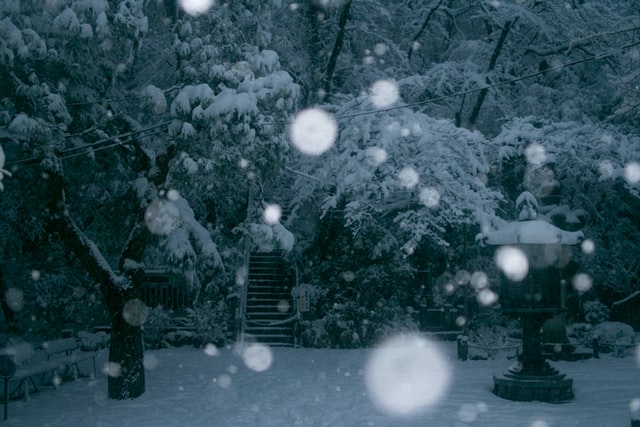
Tonight, I look outside, into the darkness, where the only light comes from the faint glow off the newly fallen snow. I listen to the breeze shaking the trees, rattling the house, causing the chimney to whistle.
Unsplash | Takemaru Hirai
During an awful pandemic that mostly restricts, in the midst of a Minnesota January, freedom can sometimes be found. There are options for what to do I don’t remember always having.
There are times when I light a fire in the fireplace and drink some herbal tea before settling into some pleasure reading, writing, or Netflix. Occasionally, a family member joins me for a game of Yahtzee or Quirkle. Some nights I go upstairs and settle into my tub, surrounded by candles, smells of lavender, and classical music played by Alexa.
In the past, I probably would have interpreted these unstructured, unplanned, unexciting nights as “boring.” However, I’m now finding power in reframing them as opportunities to “settle.”
One of the fresh perspectives I’ve appreciated this year is that of Sikh activist, best-selling author, and popular TED talk speaker, Valarie Kaur. A few months ago, on Twitter, Kaur asked:
“Over the course of [this year], what have you discovered is most essential to YOU?”
I posed this question (virtually) last week to a group of students I help lead through a Christian student club on my campus, and their responses were thoughtful. “Time outside in nature,” one said. “Being able to easily and physically spend time with family and friends,” said another. “Or just brief interactions with strangers at the store,” I added. “Hugs,” someone said, before following up by saying “and things to do outside the house.” “Moving my body,” added someone else. “Knowing that I am not in control and that I need a source I can ultimately trust,” reflected another.
Sometimes, what is most essential is what we have long taken for granted.
Unsplash | Ben White
As Frederick Buechner once said:
“Listen to your life. See it for the fathomless mystery that it is. In the boredom and pain of it no less than in the excitement and gladness: touch, taste, smell your way to the holy and hidden heart of it, because in the last analysis all moments are key moments, and life itself is grace.”
The year 2020 was not a wasted year. It was a year ripe for listening to our life experience. May we learn from our life and intentionally create something new and better – for ourselves and our communities – in 2021.
It’s been quite a year. With all the losses of 2020, one plus has been more time for me to write. Many new people started reading and following the blog this year, and for the first time, I’ve published several excellent guest blogger’s posts. Along with everyone else, the COVID pandemic was top of mind for me, and that was reflected in the themes of my writing.
As a way to review this year, below are the top posts of 2020 on this blog. If you haven’t had a chance to read these articles yet, this might be an interesting time to do so.
This is a personal confession with some of my struggles with church and religion, in light of new research published this year on people who are “done.”
This was, by far, the most popular post on the blog this year. It revisits themes of posts I wrote years ago, but seemed to find new popularity – particularly in South Africa – in light of students made to learn at home.
***
Unsplash | Immo Wegmann
Reviewing this year in writing like this makes me wonder about what themes and developments will arise in 2021. Hopefully one of hope!
I’ve been collaboring with Springtide Research Institute for some time, in various capacities, and I’ve been so impressed with their surveys and analyses about themes of loneliness, religion, and the importance of mentoring in young people. The following guest post is from Springtide’s media relations’ specialist, and is very timely. Hope you enjoy!
~Andy
***
It’s an experience so common it might be considered a holiday cliché if it weren’t true: that inevitable, excruciating barrage of questions, often directed at young people about their accomplishments, goals, or plans.
I’ve experienced it firsthand, when I announced to my now-wife’s family we were getting engaged and was immediately grilled by an uncle about my employment status and earning potential. But others have it worse. I cringe recalling a family member’s boyfriend being interrogated, then advised, then compared to others about his life choices, prospects, and setbacks. He’d had a particularly difficult year, and the onslaught of questions from an intoxicated aunt bordered on cruel. He did his best to remain calm and composed, but he had arrived ready to relax, eat, and chat light-heartedly.
In fact, that’s what most young people are hoping for – and this holiday season, when many have undergone incredible stresses, it’s more important than ever to be sensitive about heavy or hard conversations.
Well over half of young people – about six in ten – do not want to talk about difficult things during the 2020 holidays because they want it to be a time of joy and lightheartedness. Who can blame them? Studies have found that Gen Zers have been the biggest losers during the pandemic in terms of the job market, the economy, mental stress, and depression. Even more, as reported in Springtide Research Institute’s November, 2020, survey of 2,000 young people aged 13-25, 44% wouldn’t feel safe, welcome, or encouraged to have vulnerable conversations about difficult topics over the holidays this year.
Unlike older adults, young people – and particularly those under the age of 18 – do not always have the freedom to opt out of in-person holiday gatherings. I still remember the subtle threats my father used to ensure I was present at family holiday parties, despite my complaints from time to time. Now that 2 in 5 Americans have confirmed they will attend holiday gatherings this year with 10 people or more, it appears there will be plenty of opportunities for older adults to do right by young people, who would rather avoid trying to debrief or grieve the difficult year they’ve had.
With that in mind, here are a few tips for adults hoping to be hospitable to young people at holiday gatherings this year.
In the Christian calander, Advent refers to the four Sundays and weeks leading up to the celebration of Christmas. In Latin, Advent means “coming,” and this season provides a window in time for Christians to intentionally dwell in a spirit of longing, hope, and patient waiting and anticipation. In a year of public health crisis, financial and work uncertainty, racial unrest, and political strife, this emphasis strikes a new resonance in our life experience and has the potential to impact us more powerfully than in the past.
As I seek to understand and live out my faith, I find I become consumed, from time to time, with different perspectives and voices. As I look on my bookshelves, for example, I am fondly reminded of times where I have been enamored by the insights of Frederick Buechner, Shane Claiborne, Kathleen Norris, Parker Palmer, Barbara Brown Taylor, and, of course, C. S. Lewis, among others. Recently, I have acquired a new hero: Kate Bowler.
Kate Bowler
Kate has put out a free Advent devotional, and I find I am profoundly drawn in by her thoughts, as she so beautifully and compellingly connects traditional Christian faith with the suffering of this year and this moment. Part of this ability surely stems from her own experience and struggle with as someone who suffers as a stage IV cancer patient, (which she discusses in her amazing TED talk). For example, in the “liturgy” she shared today, Kate invites us to pray:
“blessed are we with eyes open to see the suffering from pandemic danger, sickness and loneliness, the injustice of racial oppression, the unimpeded greed and misuse of power, violence, intimidation, and use of dominance for its own sake, the mockery of truth, and disdain for weakness or vulnerability, and worse, the seeming powerlessness of anyone trying to stop it.
blessed are we who despair for our democracy, and ask: what can we do to protect it?
blessed are we who ask: where are you God? and where are Your people the smart, sane, and sensible ones who fight for good?”
***
As I meditate on these words, I am stunned by the realization of how much pain this year I have consciously or unconsciously tried to suppress. I feel my perspective broadened and made more whole by inviting and welcoming “eyes to see” those who are sick, lonely, and oppressed. I recognize, afresh, the extent to which truth, weakness, and vulnerability are being mocked, and how that makes all the problems we’re facing worse. I appreciate the despairing concern for our democracy and world. And, I agonize over why “God’s people” so often are part of these problems, and why they are not more often involved in the fight for good.
This prayer validates my experience and urges me to have more empathy for those who are struggling right now and do what I can to help. As Kate concludes her “liturgy,” it builds a conviction to “take hold of hope, as protest.”
As we look toward Christmas this year, we do so with a realization that God doesn’t shy away from awfulness (like I tend to do). In fact, God enters in vulnerably – rejected, in the midst of a genocide, and in the humble form of a baby. Emmanuel remains with us, in suffering, and God calls us to be present, in suffering, as well.
Last week, I stumbled upon an opportunity to join a Zoom book club in South Africa in which famed Yale theologian, Miroslav Volf, agreed to participate. I’ve admired Volf for years, beginning with this interview in which he expounds upon some of his ideas about religion, genocide, and violence. I ultimately featured many of his insights in this piece I wrote about Christianity and the Holocaust.
To my surprise and delight, there were only a handful of people in the zoom call, which gave me stunning access to Volf. My daughter joined me over lunch, and we ended up discussing themes raised related to Christianity, genocide, racism, and social justice.
Miroslav Volf
What most struck me during this discussion was a comment Volf made, in passing, which I paraphrase to the best of my memory here: “Every time I post to social media, I pray: ‘Lord, make me an instrument of your peace.‘” The thought was that, if the message to be sent didn’t line up with this prayer, Volf would change it, but if it did line up, the prayer was for the message to have this intended effect.



 Andy Tix